

| Building a Secure AI Ecosystem with Zero Trust Security Architecture
Companies are adopting various AI agents to automate work and improve productivity, but security risks are surging in proportion. In 2024 alone, AI-related security incidents increased 56.4% year-over-year, with 233 cases reported, and 13% of organizations experienced a breach of an AI model or application. Unlike existing users, AI agents pose a new dimension of security risk due to characteristics such as continuous 24-hour operation, simultaneous access to multiple systems, and autonomous decision-making. At the same time, as the adoption of AI tools outside the control of security departments increases, the possibility that sensitive data is transmitted to unidentified AI models or improperly used for training is also growing.
Even though many organizations recognize these risks, still less than two-thirds of organizations have actually implemented comprehensive security measures. In particular, when AI agents work across multiple systems, it is difficult to apply consistent security policies with separated security solutions alone, and delays can occur in threat detection and response. A lack of appropriate governance and control over AI increases the likelihood that this will lead to serious security incidents.
Core of AI Security: Applying Zero Trust Principles
The core of AI agent security is applying Zero Trust principles to the AI environment. Existing perimeter-based security models cannot effectively control the dynamic and complex behavior patterns of AI agents. On the premise of trusting no AI agent, identity must be verified every time, only minimum privileges granted, and all activity monitored in real time.
AI Zero Trust security consists of the following core elements. First, identity verification and continuous authentication of AI agents. Second, minimum privilege granting and dynamic privilege management according to work purpose. Third, real-time monitoring and logging of all AI agent activity. Fourth, immediate blocking and response upon detection of anomalous behavior. To actually implement these principles, four core layers — AI agent central control, identity management, dynamic credential management, and integrated monitoring — must be organically linked together.
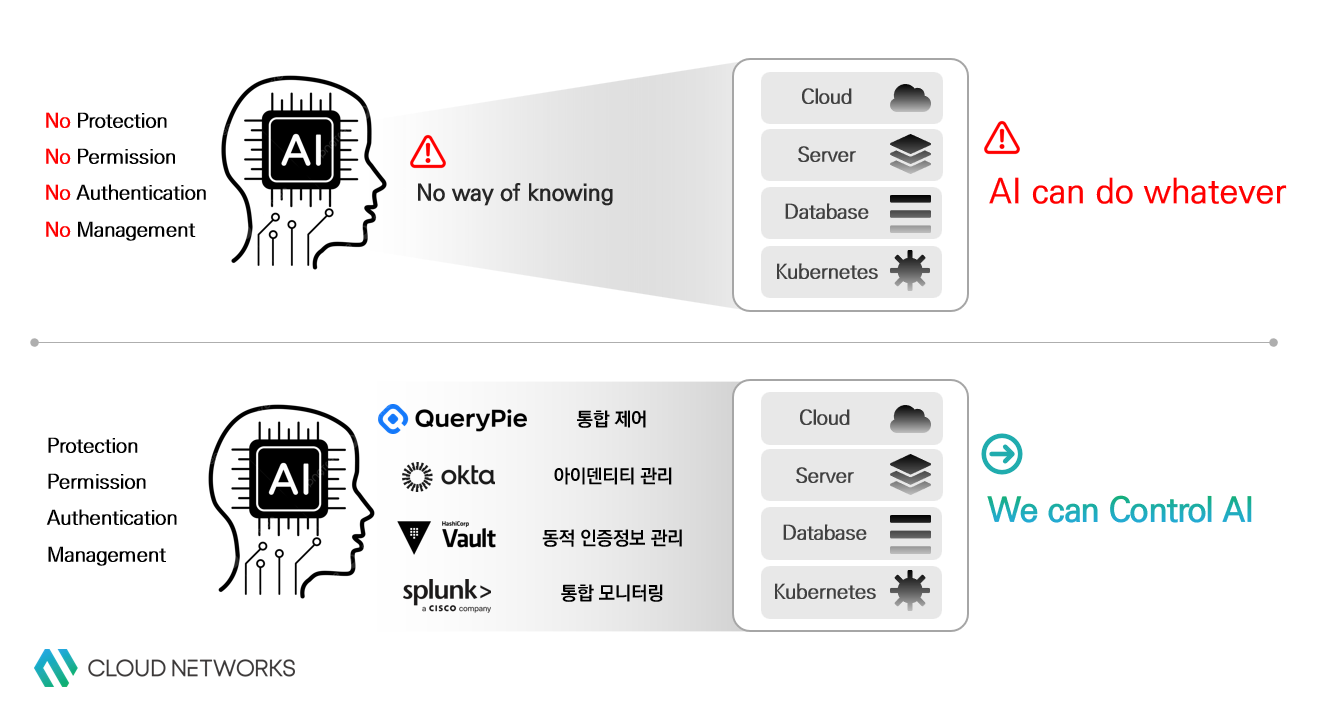
1. AI Agent Central Control: The Starting Point of All AI Activity
The first layer of AI Zero Trust security is centralized control over AI agents. QueryPie's AI platform, based on MCP (Model Context Protocol), centrally and integrally controls the various AI models and agents within an enterprise. All AI requests must pass through this hub, and are approved or blocked according to predefined policies. At this layer, AI and SaaS can be used freely while still applying the controls of Zero Trust principles. A security layer is placed between users and AI apps, applying access control according to user privileges, and control policies such as auditing, behavior analysis, and DLP are applied in real time. At the same time, granular access control over databases, systems, Kubernetes, and web applications restricts AI agents so they can access only the resources they need.
2. Identity-Based AI Security: Trustworthy AI Identity Management
The second layer is identity management for AI agents. Okta extends Auth0 to AI agents through the Cross App Access protocol, enabling AI agents to securely access various applications and services. Every AI agent is given a unique digital identity, and based on this, undergoes continuous authentication and privilege verification. At this layer, humans and the AI workforce are managed in an integrated manner. The entire lifecycle of an AI agent, from registration to decommissioning, is managed, and past identity threat event and potential access risk data are leveraged to support optimal governance decision-making. In addition, intelligent, natural-language-based policy management allows consistent security policies to be applied even in complex AI environments.
3. Dynamic Credential Management: Just-in-Time Security
The third layer is dynamic security credential management. HashiCorp Vault provides AI agents with traceable, short-lived identities instead of static credentials. It ensures that AI agents are granted only the privileges necessary to perform a specific task, and only for a minimal amount of time, thereby minimizing the risk of credential leakage. This is the core mechanism for realizing Zero Trust's key principle of "least privilege." By dynamically granting AI agents only the privileges needed at each step as they carry out complex work processes, the security risk of the overall system can be substantially reduced. All dynamic credentials expire automatically and can be immediately revoked when necessary, enabling rapid response.
4. AI-Based Integrated Monitoring: Intelligent Threat Detection and Response
The final layer is AI-based integrated monitoring and response. Splunk uses domain-specific AI to analyze events occurring at every layer in real time and automatically detect anomalous patterns. A Triage Agent automatically classifies and prioritizes large volumes of security alerts, while a Malware Reversal Agent analyzes suspicious code to determine whether it constitutes a threat. At this layer, the normal behavior patterns of AI agents are learned so that abnormal activity can be detected quickly. Natural-language-based investigation tools allow security personnel to easily and quickly analyze security events occurring in complex AI environments, and automated responses enable threats to be blocked in real time.
How the Integrated Architecture Actually Works: Systematic Implementation of AI Zero Trust
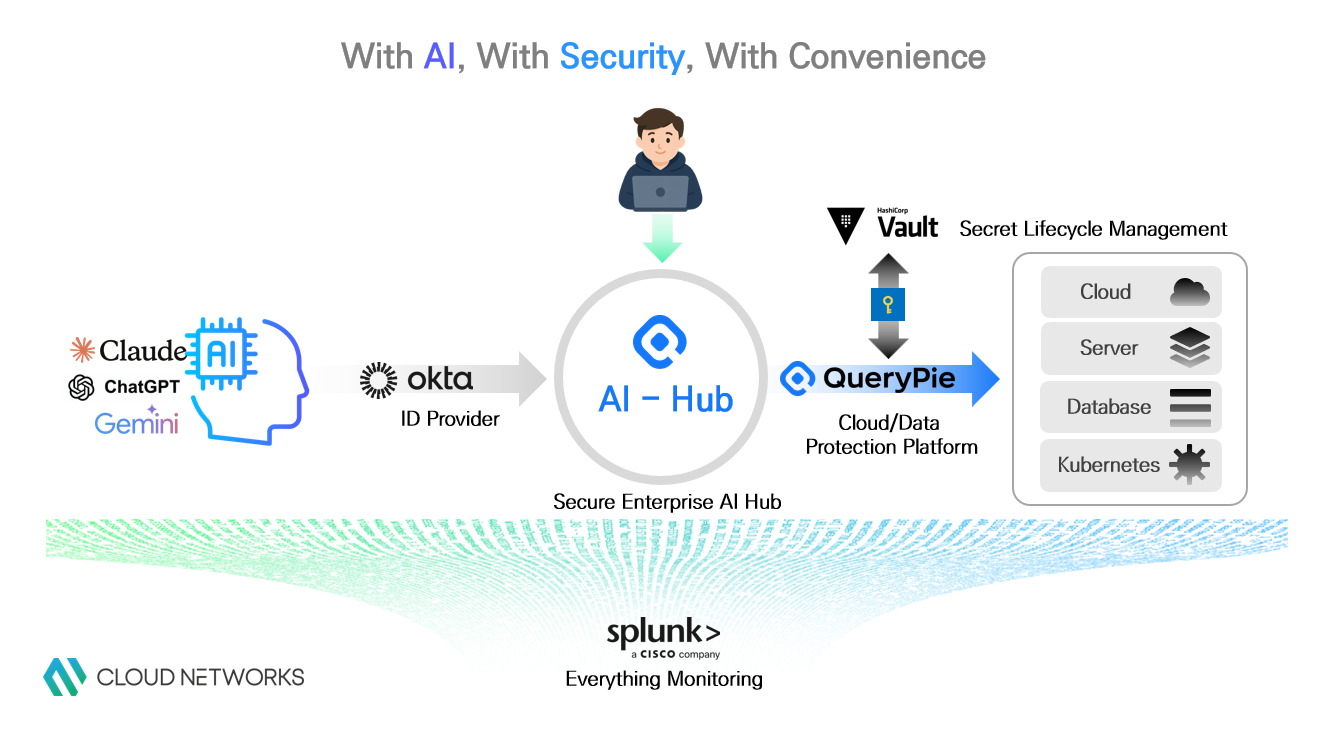
When these layers are integrated and operate together, a systematic AI Zero Trust security environment is realized. When an AI agent requests a task, policy verification is first performed at the central control layer via the MCP protocol. The identity layer then verifies the AI agent's identity and grants privileges. The dynamic credential layer then provides only the minimum privileges needed for that task, for a short period of time. The entire process is monitored in real time at the integrated monitoring layer, and is immediately blocked if any anomaly is detected.
The core of this approach is that each layer operates independently while still being organically linked together. When a security threat is detected at one layer, the other layers immediately switch to response mode as well, preventing the spread of the threat. In addition, all AI agent activity is transparently recorded, satisfying both post-incident analysis and compliance requirements.
AI Security: Not an Option, But a Necessity
As the use of AI and cloud in the public and financial sectors becomes freer, AI security is becoming an increasingly urgent task. Companies can no longer delay AI adoption, but adopting AI without security can instead cause even greater risk.
An integrated AI security architecture based on Zero Trust is a proven approach to resolving this dilemma. It provides a systematic solution covering the entire security lifecycle, from central control of AI agents to identity management, dynamic security, and intelligent monitoring.
CloudNetworks possesses the capability to build this kind of integrated AI security architecture through partnerships with leading companies in each domain, including QueryPie, Okta, HashiCorp, and Splunk. Rather than simple product supply, it provides optimal architecture design and implementation services tailored to a customer's stage of AI adoption and security requirements. What matters is that this architecture provides strong security without hindering AI innovation. Rather, by building a secure AI environment, it lays the foundation for companies to utilize AI even more actively. AI has already become a reality. Now is the time for a Zero Trust security architecture for the safe use of AI.