

☑️ What Is an ADC (Application Delivery Controller)?
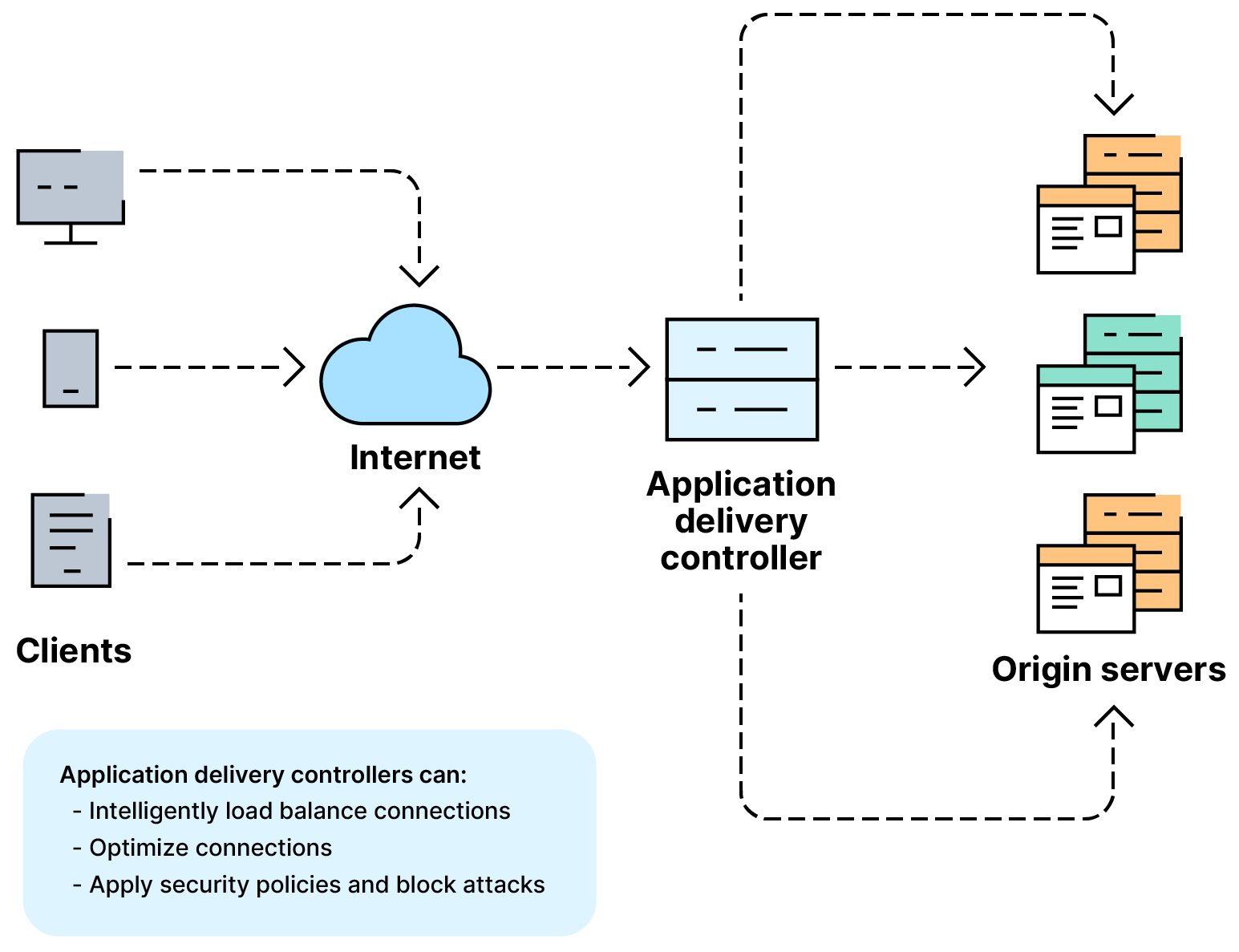
An application delivery controller (ADC) is a network device designed to improve the performance, security, and resilience of applications delivered over the web. ADCs are gaining attention as traditional load balancing devices face a growing need to handle more advanced application delivery requirements and improve application performance.
☑️ Why Do Enterprises Use ADCs?
Applications have evolved considerably over the years. Today, the term "delivery" is generally understood to mean how applications are provided to users in the mobile and cloud era. In the enterprise, business applications are no longer limited to desktop-based software installed on local servers and have moved away from being accessed by users over a LAN. Modern applications must work over every type of network and be accessible from a variety of locations beyond the physical workplace.
Widely deployed as an essential component in the enterprise, application delivery controllers (ADCs) help applications adapt to the networks and protocols in use today. They also ensure that applications perform optimally, are always available, and do not create security risks for users or the enterprise.
This is especially important as hybrid work environments grow. Typical consumers expect the devices and applications they use every day to always work smoothly and to deliver the information they need instantly. These expectations carry over directly to the devices and applications they use for work. To satisfy today's workers, business applications must be as intuitive and easy to use as the applications they use for personal tasks or entertainment. Many employees no longer need to use only limited company-owned equipment and can use their personal devices to work whenever they want. Because people can work at any time of day, IT departments must keep business servers and applications available 24 hours a day. To this end, enterprises invest heavily in IT infrastructure to ensure that employees can access applications and information whenever they need them.
Of course, servers can fail for a number of reasons, including mechanical faults, overload, and security breaches. When a server goes down, the applications running on it become unavailable or inaccessible. IT organizations can build fault-tolerant environments to prepare for such situations. Placing additional servers in a data center or co-location site is a common failover strategy. By distributing application workloads across clusters of active servers at one or more sites, ADCs can provide seamless failover and ensure high availability of applications.
☑️ How Does an ADC Work?
Application delivery controllers (ADCs) use algorithms and policies to determine how inbound application traffic is distributed. Round robin is a basic form of load balancing that forwards client requests to each server in turn. This method assumes that all servers are identical and does not consider server health or responsiveness. Administrators can implement additional policies that have the ADC check multiple criteria before deciding which server to send an inbound request to. The ADC can inspect packet headers for keywords or requested file types and then forward the request to the appropriate server based on this information.
Application delivery controllers also provide powerful monitoring capabilities. They can check server health and operational availability beyond basic ping tests. If monitoring shows that a server has a problem or does not meet certain criteria that ensure its reliability, the ADC redirects traffic to an alternate server to prevent service disruption.
ADCs can also perform real-time and historical analysis of all user and network traffic. This includes metrics such as round-trip time (RTT), bandwidth usage, and data center and wide area network (WAN) latency. This information helps help desk staff quickly identify the source of problems and gives users faster resolution.
☑️ How Do ADCs Help Improve Application Performance?
Optimization Tailored to User Needs
When applications fail to meet user expectations, productivity can drop significantly. ADCs can use a variety of mechanisms to improve application performance, particularly on mobile and high-latency networks. SQL database load balancing is one way to improve performance. SQL load balancing is similar to the techniques used in TCP traffic load balancing but applies them at the database level. By handling each SQL transaction using policy-based logic, it increases the number of requests and connections that can be processed within a database cluster.
Other common performance optimization features provided by application delivery controllers include offloading server-intensive tasks, connection multiplexing, compression, and caching. SSL and TLS are essential elements of web business. Managing traffic protected with modern encryption can place a significant load on the CPU. ADCs can handle large volumes of encrypted and unencrypted traffic, perform certificate management, and decrypt traffic before it reaches the servers.
TCP multiplexing is an effective way to handle large volumes of inbound server requests. TCP multiplexing maintains active connections between the ADC and the servers. When traffic reaches the ADC, it routes requests over open channels, eliminating the inefficient "open-close connection" overhead incurred with each transaction and preventing server performance degradation.
Optimization on Mobile Networks
Application delivery controllers (ADCs) can also deliver performance improvements on mobile networks. Web pages designed with high-speed internet connections in mind often fail to provide the same user experience on bandwidth-constrained mobile networks.
ADCs can use several creative mechanisms to optimize web content delivery on mobile networks. Domain sharding is one example. Connection-layer optimization is applied to a single domain, splitting the content of each page across multiple subdomains so that more channels can be opened simultaneously. This can shorten page load times and improve performance. ADCs can analyze the content being delivered and convert GIF files to the more efficient PNG format, improving the load speed of web pages that contain large images.
Other key elements of web pages include scripts and CSS (Cascading Style Sheets) files. ADCs can compress these files by removing unnecessary characters and whitespace. Compressed files travel across the network much faster, significantly reducing download times.
☑️ How Do ADCs Help with Application Security?
Delivering applications over the web has introduced new threats and vulnerabilities that did not need to be considered with traditional LAN-based applications. As employees become increasingly mobile and the need to access applications and data remotely grows, IT departments must put stronger security measures in place to prevent external attacks and data leaks.
Application delivery controllers (ADCs) act as a natural entry point or gateway to the network. The ADC authenticates each user attempting to access an application. If the application is SaaS-based, the ADC can verify the user's identity using an on-premises Active Directory data store, eliminating the need to store credentials in the cloud. This approach not only strengthens security but also improves the user experience by providing single sign-on (SSO) across multiple applications.
SAML is an XML-based protocol widely used today to streamline application login processes. The ADC can act as a SAML agent, authenticating users through various data stores that can verify user identity. Some applications use credentials from sites such as Facebook or Google to verify user identity before granting access. In this role, the ADC can act as a SAML identity provider (IdP) or service provider (SP).
ADCs can implement rate-limiting measures to protect internal server resources from distributed denial-of-service (DDoS) attacks. DDoS attacks are becoming more frequent, with enterprise web services in particular becoming major targets of attempts to overload servers and disrupt business operations. When an abnormally large volume of inbound requests occurs, the ADC can throttle these requests or minimize consumption of available bandwidth, and in some cases block the requests entirely.
Application delivery controllers (ADCs) combine load balancing with advanced Layer 7 security capabilities. Previously, web application firewalls (WAFs) for application-layer protection were offered as separate, standalone solutions. A WAF inspects data packet headers for suspicious content or malicious scripts that network firewalls may not detect. Today, most ADCs offer WAF capabilities as an option, helping to strengthen both security and performance at the same time.
Application delivery controllers (ADCs) can support both a Positive Security Model and a Negative Security Model. When an ADC is set to "Learning" mode, it can analyze traffic to identify usage patterns that represent normal behavior. For example, when malicious inbound requests such as SQL injection or cross-site scripting (XSS) are detected, it can automatically identify and block them. ADCs can also use signature-based protection through integration with third-party security providers such as Qualys. By combining these protection methods, the ADC can implement a comprehensive hybrid security model for applications and users.
☑️ What Is the Future of the ADC?
ADCs already play an important role in securely delivering applications and data for IT organizations. However, as applications continue to evolve, ADCs are expected to keep evolving as well. With advances in software-defined networking (SDN), there is a growing need for ADCs to move away from traditional approaches and deliver their capabilities "as a service" (ADC-as-a-Service). In addition, as network protocols become increasingly application-centric, ADCs must evolve into more "self-automated" forms that provide seamless optimization and protection for all types of applications.
☑️ NetScaler - Application Delivery and Security Platform
NetScaler goes beyond load balancing to provide advanced application delivery capabilities for multi-cloud environments.
NetScaler is the only application delivery and security platform that lets you manage all ADC operations in one place. Because it is built on a single code base using a software-based architecture, it ensures the same behavior regardless of which ADC form factor you choose, whether hardware, virtual machine, bare metal, or container. It is environment-agnostic, intent-based, API-driven application delivery for multi-cloud environments. For more details about the product, including how it works and its features, visit the product page!
Through its dedicated team with industry-leading technical expertise, CloudNetworks provides technical support services for NetScaler. For inquiries about NetScaler, please contact CloudNetworks, an official partner.