

As AI agents become the new digital workforce in enterprises, "Shadow AI" operating outside the control of IT departments is emerging as a new blind spot in enterprise security. To address this problem, global identity security company Okta announced the Agent Discovery capability within ISPM (Identity Security Posture Management).
In this blog post, we look at why Shadow AI is more dangerous than traditional Shadow IT and whether an identity-centric security strategy is the answer.
🔵What Changed from Shadow IT to Shadow AI
Shadow IT is not a new problem. Employees adopting SaaS tools without IT department approval has been going on for a long time. However, AI agents have three characteristics that are fundamentally different from traditional Shadow IT.
First, they operate at a different layer. While traditional Shadow IT was mainly a problem at the level of individual apps, AI agents operate at the application layer and exercise broad, long-lived privileges through multiple non-human identities (NHIs).
Second, they are created and spread at a different speed. With the spread of agent builder platforms, every employee can now provision digital workers directly. When an employee grants OAuth permissions to an unvetted tool, data can flow outside the security perimeter at that very moment.
Third, the blast radius is different. When an unauthorized agent connects to core systems, the compromise of a single agent can have a cascading impact on multiple apps and data. James Simcox (COO/CPO) of Equals Money points out, "If AI agent products come in connected to multiple services without anyone knowing, that's a real problem."
According to Gartner's 2025 survey, 69% of organizations suspect or have evidence that employees are using unauthorized GenAI tools, and Gartner predicts that by 2030, more than 40% of enterprises will experience security or compliance incidents caused by unauthorized Shadow AI. According to data from Okta's "Okta for AI Agents" solution page, 91% of organizations are already using AI agents, but 44% have no governance at all.
🔵Visibility, Not Blocking: Why Traditional Approaches Don't Work
The most intuitive response to Shadow AI is blocking. However, there is a growing consensus in the field that blocking actually makes the problem worse.
Amar Akshat (SVP Technology & Chief Architect) of Paysafe points out, "If you block, you're only blocking visibility. The AI landscape is evolving so fast that blocking just makes usage invisible." KPMG's 2025 survey also found that almost half of US workers are using AI tools in unauthorized ways. Employees choose unauthorized tools over official ones for speed and convenience, and simple blocking does not address this root cause. This is also why Simcox of Equals Money said, "We rolled out ChatGPT to employees before they did it themselves." Increasing access to approved tools is the first step in reducing the spread of Shadow AI.
However, providing approved tools alone is not enough. Traditional network- and endpoint-based security approaches do not apply to AI agents, because AI agents operate at the application layer rather than the network or device layer. What is needed, therefore, is visibility into where agents exist, who created them, what data they access, and what privileges they hold, in other words, an identity-centric approach.
The problem of "permission inheritance" also cannot be addressed without visibility. According to Okta's "AI at Work 2025" report, only 36% of organizations have a centralized governance model for AI, and only 10% have an NHI management strategy. Even if an employee with administrator privileges hands over all of their privileges to an AI tool, there is no way to detect it without visibility.
🔵Okta's Solution: Agent Discovery in ISPM
Okta's answer to these problems is the Agent Discovery capability within ISPM (Identity Security Posture Management). Announced on February 12, 2026, this capability is a core component of the "Okta for AI Agents" solution, designed to detect Shadow AI and bring it into the governance framework.
Agent Discovery addresses three problems.
Agent Discovery starts by detecting OAuth consent. Integrated with browsers such as Google Chrome, it captures in real time the moment an employee grants an AI tool (Client App) access to corporate data (Resource App). This makes it possible to map which agents have what level of permissions (scope) to which data sources, and to trigger alerts when an unauthorized agent gains permissions to critical data.
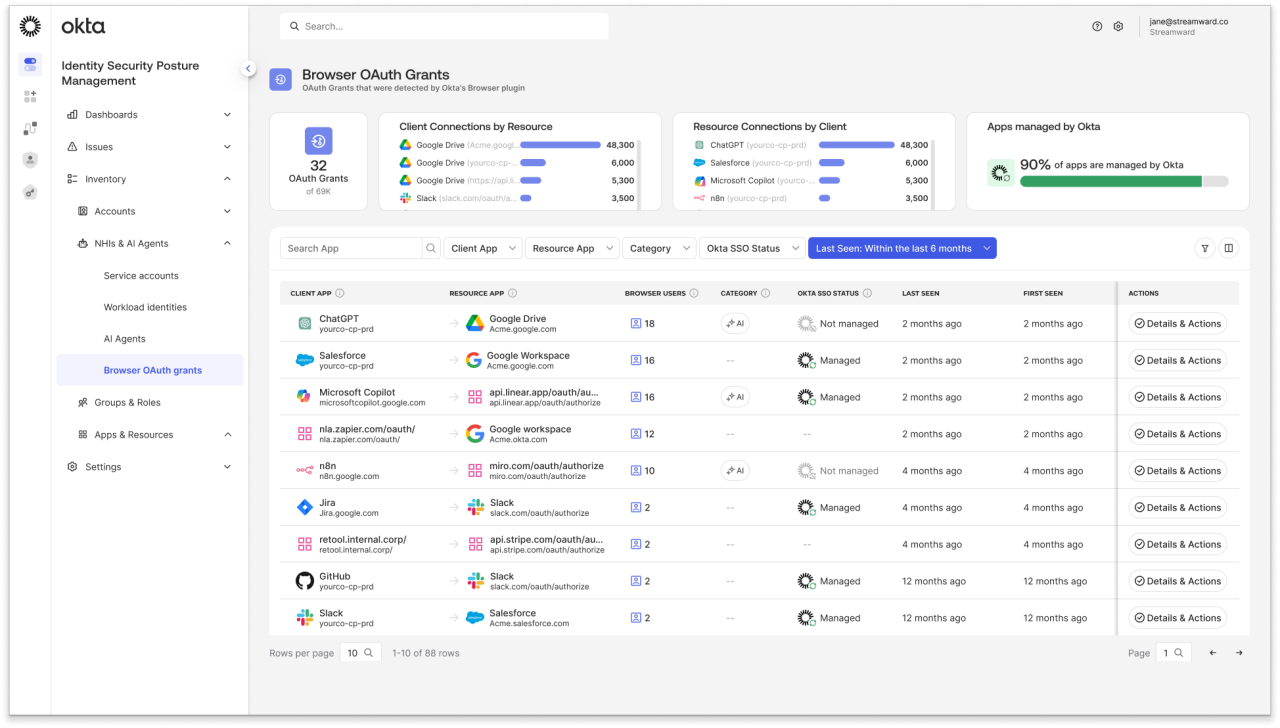
What matters is the action taken after detection. Discovered agents are registered as managed identities on the Okta platform, security policies are applied, and a human owner is assigned. The core value of Agent Discovery is that it does not stop at simply finding Shadow AI but converts discovered agents into managed assets subject to governance.
🔵A Four-Stage Playbook for AI Agent Security
Through its blog, Okta presented a four-stage playbook for gaining control over AI assets. Each stage progressively expands the scope of visibility, ultimately creating a structure in which all agents are managed on a unified identity platform.
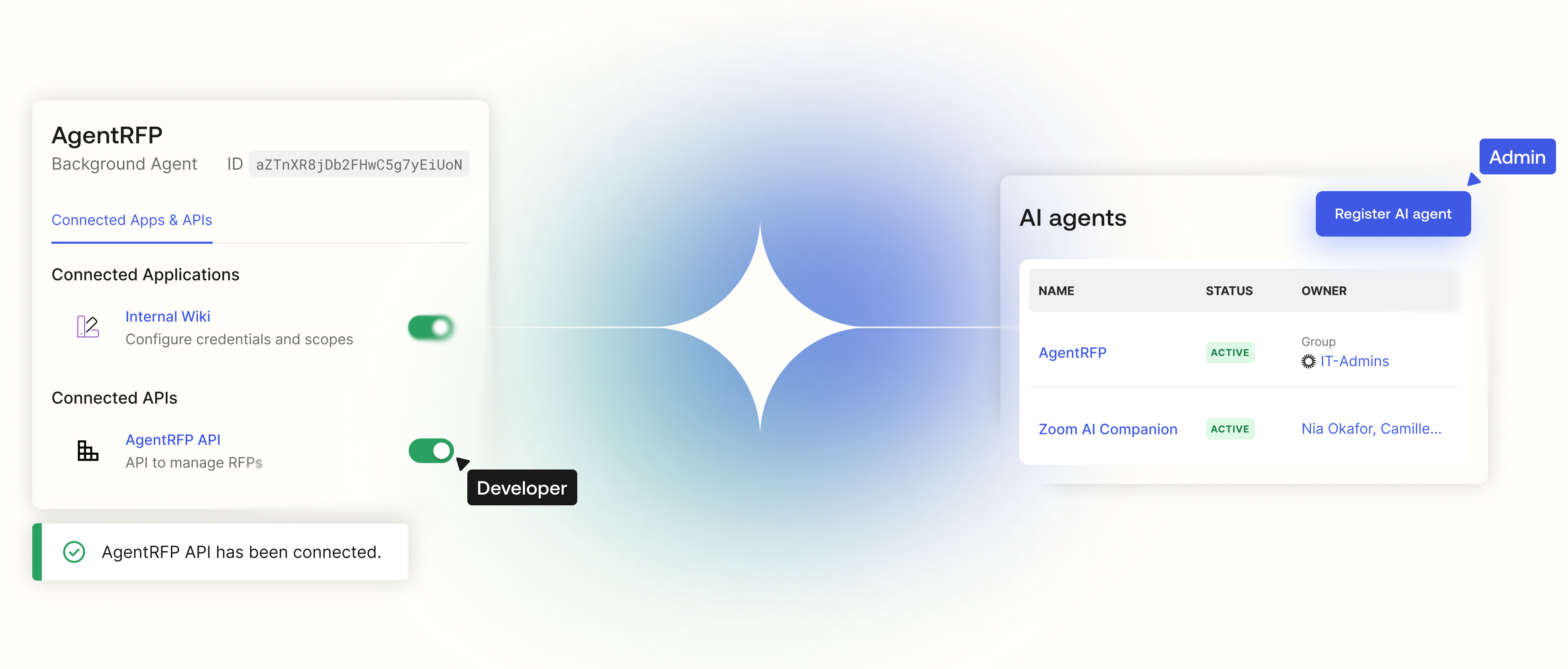
Stage 1: Identify Agents Within Approved AI Platforms
Even on AI platforms officially approved by the enterprise, such as Microsoft Copilot, Salesforce Agentforce, AWS Bedrock, OpenAI, and Google Vertex AI, security teams often do not know which agents are operating with which privileges. Approval itself does not guarantee visibility. The number of agents is so large that manual oversight is virtually impossible, and it is difficult to detect situations in which agents are granted excessive administrator privileges for ease of configuration or in which access between production and development environments is connected indiscriminately. Okta provides an automated inventory of these "Crown Jewel" environments, identifying each agent's owner, actual privileges, and key risk locations.
Stage 2: Detect Unknown Agents on Unapproved Platforms
While most organizations focus on a small number of approved tools, the attack surface expands across departments through unapproved platforms, unvetted agent builders, and hidden MCP servers. The key risk driver is OAuth permission grants (User Consent). When an employee grants corporate data access to an agent they built themselves or brought in from outside, that agent obtains an OAuth token that allows it to access data and perform tasks on the user's behalf. Okta's SAM (Secure Access Monitor) browser plugin feeds real-time OAuth signals into ISPM to identify agents on unapproved platforms, excessive permission (scope) exposure, and Shadow SaaS that has bypassed legal and privacy reviews.
Stage 3: Harden the Non-Human Identity (NHI) Layer
An AI agent is not a single "bot" but operates on top of multiple non-human identities (NHIs), such as API tokens, access keys, service principals, and OAuth tokens. To truly protect AI agents, organizations must harden not only the agents themselves but also the technical keys that enable them to act. This requires deep visibility into the graph connections among the AI agent, the person who created it, the specific NHIs that power the agent, and the apps the agent can access. Okta provides visibility into various NHI types across SaaS, IdP, cloud infrastructure, and on-prem AD in a single view, and proactively identifies high-risk vulnerabilities such as excessive privileges and unrotated credentials through detection of more than 25 prioritized risks mapped to the OWASP Top 10 for NHIs.
Stage 4: Consolidate onto a Unified Identity Platform
The final stage is to consolidate the AI agents discovered in the previous three stages and their underlying NHIs onto the same identity platform. Because Okta is platform-neutral, it can detect agents regardless of their source, and this consolidation makes it possible to apply consistent security policies across the entire human and non-human workforce. Applying the same policies to AI agents as to human employees is the ultimate goal of identity-based AI security.
🔵The Core of AI Security Is Identity Security
The most important premise in AI agent security is that AI agents are ultimately "identities." Agents are authenticated, granted privileges, access data, and perform tasks just like people. Therefore, the core of agent security is not building a separate new security framework but integrating agents into the existing identity security fabric.
The approach Okta presents through this Agent Discovery announcement can be summarized as follows.
In the current situation, where 80% of organizations have experienced unintended agent behavior and 23% have reported credential exposure through agents, building a framework that treats AI agents as formal identities of the organization and manages their entire lifecycle from creation to retirement is no longer optional but essential.
Shadow AI is no longer a problem that can be left unaddressed. Discovering invisible agents, converting discovered agents into managed assets, and consistently managing human and non-human identities within a single framework is the core of the identity-based AI security that Okta presents. For Okta adoption and consultation inquiries, please contact CloudNetworks, an official partner.
▶ Okta Learn More