

In the era of agentic AI, data is the foundation of digital resilience. Meet Splunk, the platform that lets you search, analyze, and act on that data anywhere, at any scale.
🔸From Data Chaos to AI-Powered Clarity
The machine data that security and IT operations teams deal with every day is still scattered and siloed across multiple systems, costs too much time and money to analyze, and is not refined into a form that AI can use right away. According to a joint study by Splunk and Oxford Economics (The New Rules of Data Management, 2025), 91% of 1,475 IT and security professionals worldwide said their data management costs had increased compared to the previous year, and 62% said data management challenges had led to actual compliance failures.
The Splunk platform addresses exactly this point. It forms the foundation of Cisco Data Fabric and turns raw machine data into structured insights. By providing unified visibility, intelligent data management, and AI-driven efficiency, it connects fragmented data and enables operational excellence across the digital environment.
🔸Splunk's Core Capabilities
1. Complete Control of the Data Lifecycle
The Splunk platform is designed to manage the entire data lifecycle on a single platform, from the moment data is generated to the point it is analyzed and used. The data types the platform handles are Metrics, Events, Logs, and Traces. It does not stop at collecting and onboarding this raw operational telemetry data but handles the entire flow through to converting it into structured, AI-powered intelligence. Data cost optimization also takes place in the process.
2. Federated Search and Analytics
Traditional data analysis required moving data to one place for analysis. This meant additional transfer costs and complexity. Splunk's Federated Search fundamentally solves this problem. Wherever the data resides, such as Amazon S3 or Amazon Security Lake, it can be searched and analyzed in place without moving it. Organizations can gain real-time insights across distributed data sources while simplifying data storage management.
3. AI-Native Intelligence
AI is deeply embedded throughout the Splunk platform. Rather than a structure in which AI is layered on top of specific features, it is an "AI-native" design in which AI operates at every stage, from data collection to analysis and investigation. A representative capability is the AI Assistant for SPL. When users enter requests in natural language, the AI automatically generates or explains queries in SPL (Search Processing Language), Splunk's powerful search language. This means even non-experts can query and analyze data directly. Complex queries and advanced analytics are also accessible through generative AI-based natural language search, allowing all users to tap into the platform's potential regardless of their technical skill level.
4. The Foundation for Agentic AI Innovation
As we move beyond simply displaying data into an era in which AI agents make their own decisions and take action based on data, Splunk has introduced two core technologies to support this.
The first is the MCP (Model Context Protocol) server. Released for Splunk Cloud Platform, the MCP server is a standardized bridge connecting AI agents to the Splunk data platform. Based on the Model Context Protocol, an open standard led by Anthropic, it allows AI assistants such as Claude and ChatGPT to communicate directly with Splunk in natural language. Users can query complex datasets and run searches without writing a single line of SPL. Because it uses Splunk's existing authentication and access controls as they are, it is also secure.
The second is the Machine Data Lake. It is a schemaless data lake that refines and enriches machine data from the pre-indexing stage so that it can be used for AI training and RAG (Retrieval-Augmented Generation) pipelines, and an alpha version was released in February 2026. It serves as the infrastructure for preparing high-quality data that AI agents can actually use.
5. Data Visualization and Reporting
Dashboard Studio turns complex data into clear, actionable insights. It provides customizable dashboards and reporting at a level that not only technical staff but also business decision-makers can use right away.
🔸The Two Pillars Supported by the Splunk Platform — Security and Observability
The Splunk platform delivers unified security and full-stack observability on a single data platform.
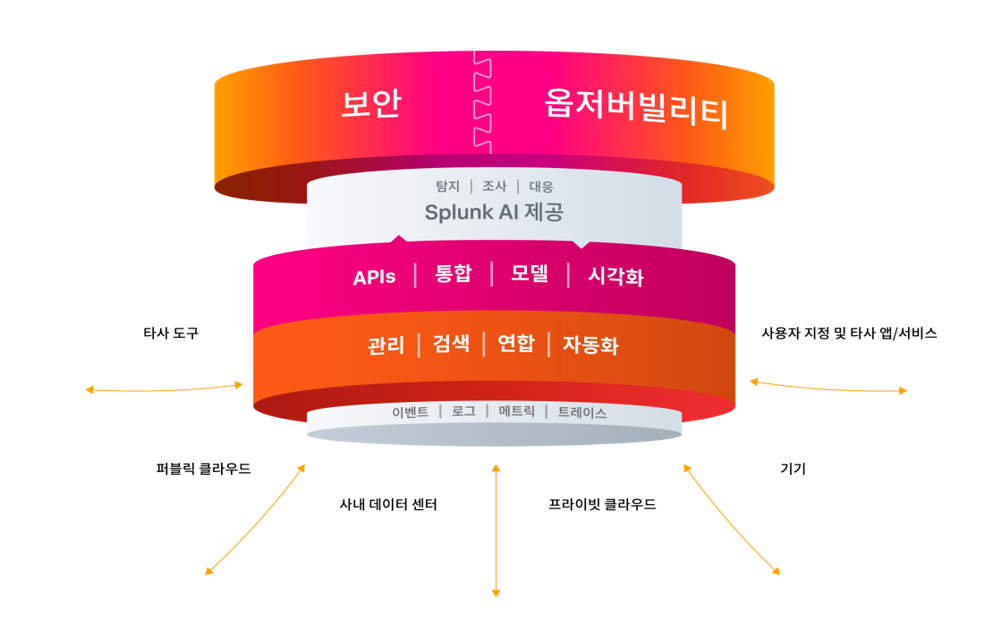
On the security side, Splunk Enterprise Security is an AI-powered SecOps platform that unifies threat detection, investigation, and response (TDIR), providing complete visibility, AI automation, threat intelligence, and high-fidelity alerts. It is designed to respond to threats accurately and quickly, and it was named a Leader in the 2025 Gartner Magic Quadrant for SIEM for the 11th consecutive year. It also ranked first in all three use cases in the 2025 Gartner Critical Capabilities for SIEM.
On the observability side, Splunk Observability provides complete visibility and real-time troubleshooting across all environments, stacks, and networks, including AI infrastructure. It enables issues to be detected proactively, prioritized based on business impact, and resolved quickly. It was named a Leader in the 2025 Gartner Magic Quadrant for Observability Platforms.
Having both areas run on a single platform means that security and IT operations can be run on a unified data foundation without having to maintain separate data silos.
🔸An Integration Ecosystem of More Than 2,000
Another strength of the Splunk platform is its vast integration ecosystem. More than 2,000 apps and add-ons are available on Splunkbase. Integrations with existing technology stacks can be set up quickly, and the entire Splunk portfolio can be used to integrate security and observability across the enterprise.
For technical support, technical information and collaborative solutions are available through Splunk Community and Splunk Lantern. The Voice of the Customer program and Splunk Ideas, through which product feedback can be submitted directly, are also in operation.
🔸Splunk Customer Stories
The Splunk platform is used in real operations by companies across a variety of industries worldwide. Click Learn More to view each customer story.
🔸A Data Platform for Digital Resilience in the Agentic AI Era - Splunk
Agentic AI is rapidly evolving beyond simply answering questions toward making its own decisions and taking action. And the performance of AI ultimately depends on the quality and accessibility of the data behind it. No matter how good an AI model is, it cannot do its job if data is scattered and unrefined.
The Splunk platform is a tool for building the data foundation that is a prerequisite for AI innovation. Going beyond collecting, unifying, and analyzing machine data to converting it into intelligence that AI agents can use in real time, digital resilience in the agentic AI era starts here.
Drawing on its expertise in data and security, CloudNetworks operates a dedicated team specializing in the implementation and technical support of the Splunk platform. For inquiries about adopting and using Splunk, please contact CloudNetworks, an official partner.
▶ Splunk View Products