

We have entered an era in which AI can discover vulnerabilities and develop exploits on its own. Attackers are getting faster, but enterprise response speed is not keeping up. To close this gap, Qualys proposes operationalizing hyper-prioritization and autonomous remediation.
☑️How Mythos Changed the Threat Landscape
Claude Mythos, unveiled by Anthropic, is a frontier AI model that autonomously discovers vulnerabilities and develops exploits. This is not just about Mythos. Other models are quickly catching up. Project Glasswing is a project to identify and fix vulnerabilities in widely deployed software, and 43% of the CISA KEV was found in Glasswing launch partners.
According to Qualys TRU Research, vulnerabilities have increased 6.5-fold over the past four years. The average time from disclosure to exploitation is 18 days, but with the emergence of AI, this is shrinking to within hours. Meanwhile, the average enterprise mean time to remediate (MTTR) remains 67 days.
That said, it is impossible to respond to the flood of vulnerabilities with the same priority. According to the same research, of the 48,172 CVEs published in 2025, only 357, or 0.74%, were actually weaponized. The challenge is determining which of tens of thousands of vulnerabilities fall into that 0.74%, and whether they are actually exploitable in your environment right now.
☑️Qualys' Operationalization of Autonomous Remediation : Three Core Strategies
To respond to the surge in threats in the post-Mythos era, Qualys operationalizes autonomous remediation around three strategies: Hyper-Prioritization, Zero-day Remediation, and AI-Speed Detection. Each strategy is implemented through three solutions: ETM, TruRisk Eliminate, and VMDR.
1. Hyper-Prioritization: Focusing Only on What Is Truly Risky
The following example is based on real customer data. It shows how a total of 62.5 million security findings are reduced step by step.
Applying threat intelligence, based on dark web trending, weaponization by real threat actors, and association with ransomware and malware, reduces findings by 96% to 2.16 million (4%). Adding asset context, based on business-critical assets such as PCI scope, internet exposure, databases, and revenue-related apps, reduces them by 99.5% to 304,000 (less than 1%). Then validating actual exploitability with TruConfirm reduces them by 99.9% to 60,000 (less than 0.1%), and remediation costs fall from $3.12 million to $31,000.
🔹Qualys ETM🔹
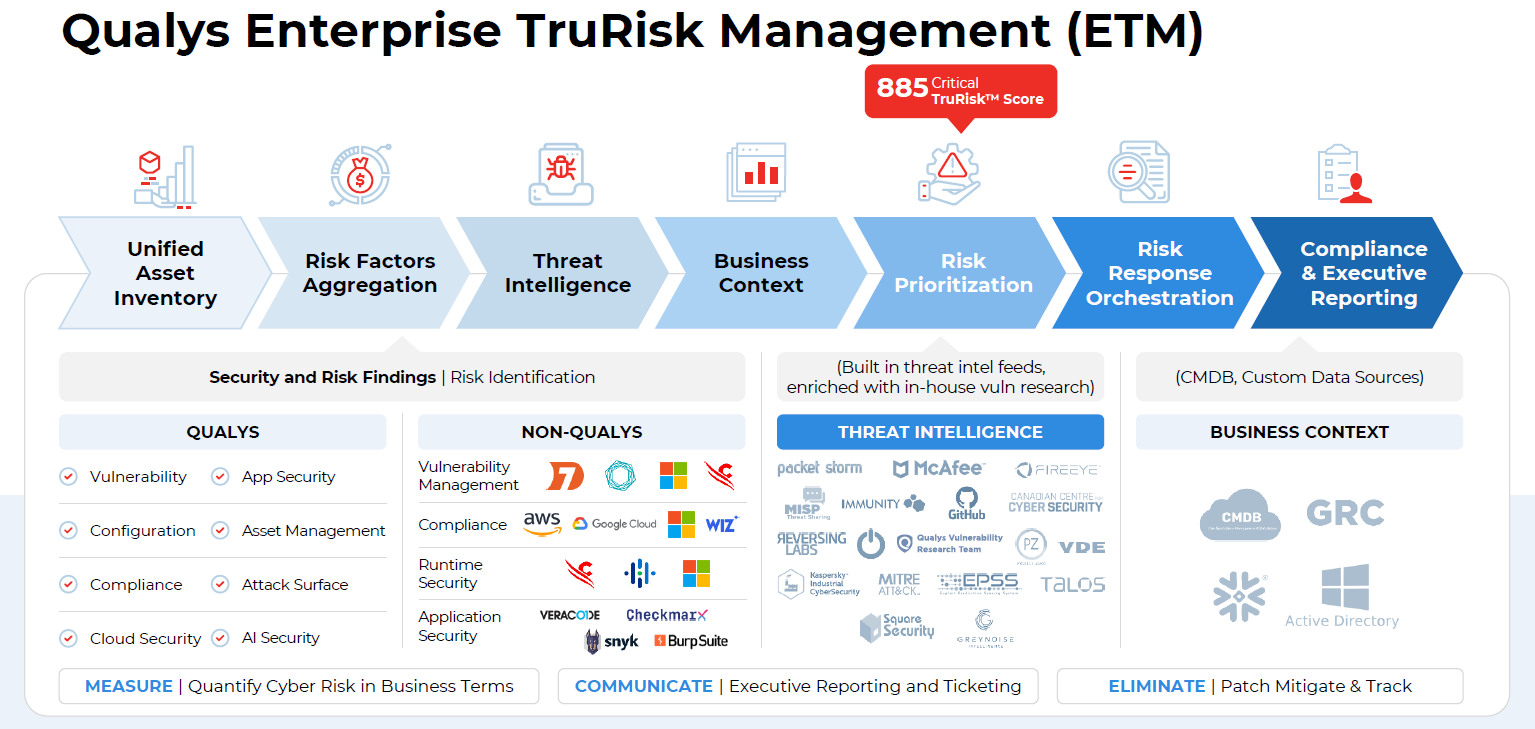
Qualys ETM (Enterprise TruRisk Management) is the core platform for hyper-prioritization. It reduces exposure noise by 98%, enabling organizations to address the most dangerous exposures before attackers do, and improves security posture threefold. ETM consists of the following six core capabilities.
For example, in the case of EternalBlue, rather than simply warning that a patch has not been applied, it classifies the finding as Exploitable only when SMBv1 is actually enabled and an attack is possible. In the case of Log4Shell, even if a vulnerable library is present, it is judged risky only when the actual attack path, the JNDI path, is enabled and intrusion is possible. TruConfirm has performed more than 8 million validations over the past 12 months and is designed with a Safety-First architecture that does not affect production environments.
Agent Val is the industry's first attack validation AI agent. It selects the next risky target to validate on its own, runs TruConfirm safely, and revalidates whether the risk has actually been eliminated once patching is complete.
2. Zero-day Remediation: Responding Even Without a Patch
In the post-Mythos era, the time from disclosure to exploitation is shrinking to hours, making it difficult to respond by waiting for patches to be released. Qualys TruRisk Eliminate is a zero-day remediation solution that can remediate vulnerabilities regardless of whether a patch is available.
🔹Qualys TruRisk Eliminate🔹
An AI-based recommendation engine automatically maps the most appropriate remediation method to each vulnerability and provides five response methods.
Patch supports zero-touch patch automation for Windows, MacOS, Linux, and third-party apps. Fix remediates vulnerabilities even when no patch is available. Mitigate reduces exposure when patching is impossible or risky. Custom provides pre-built scripts for complex cases and custom scripts for in-house apps. Isolate, as a last resort, isolates high-risk devices while remote patches are applied.
Building trust in autonomous remediation is also important. With patch confidence scores, TruRisk Eliminate makes it possible to know in advance whether a patch will work properly, and deployment waves (a four-stage intelligent rollout) allow patches to be deployed in phases, starting with less critical systems. If abnormal behavior occurs, the rollback feature can reverse the remediation, and multi-vendor environments such as Zscaler, SCCM/Intune, CrowdStrike, and ServiceNow are supported.
Looking at real deployment cases, 92,000 individually installed Zoom instances were removed and moved to an administrator-controlled secure environment. 27,000 WinVerifyTrust vulnerabilities were fixed in just three days. 40,000 .NET end-of-life vulnerabilities were resolved in 16 days, and 10,000 birthday attack-related vulnerabilities were addressed in six days.
TruRisk Eliminate was ranked No. 1 by GigaOm and has deployed more than 150 million patches over the past 12 months. More than 40 million autonomous patches have been applied, with a rollback rate of less than 0.1% and a first-attempt success rate of 98.2%. In terms of customer impact, average remediation time has been reduced by 80%, and the average time to remediate zero-days is less than one day.
3. AI-Speed Detection: Detecting Before Attackers Do
Detection speed is response speed.
🔹Qualys VMDR🔹
Qualys VMDR has a median response time of 12 hours for critical and zero-day vulnerabilities, and 6 hours for high-priority vendors. It provides industry-leading coverage of 130K+ CVEs and 99.4% CISA KEV coverage, and has maintained Six Sigma-level detection accuracy for more than 10 years. This compares with competing scanners, which take days to weeks to add signatures.
Detection speed and coverage expansion are achieved in three stages.
In addition to vulnerability detection, VMDR provides digital certificate assessment, CIS control-based configuration assessment, asset inventory, threat intelligence-based prioritization (TruRisk), and 100% ransomware exposure coverage within a single license.
☑️Qualys Platform Solutions for Managing the AI-Driven Surge in Exposures
Qualys is recognized as a category leader across all three solutions: VMDR, ETM, and TruRisk Eliminate. Each solution plays a distinct role, covering AI-speed detection, hyper-prioritization, and zero-day remediation, while operating in an integrated manner within a single platform.
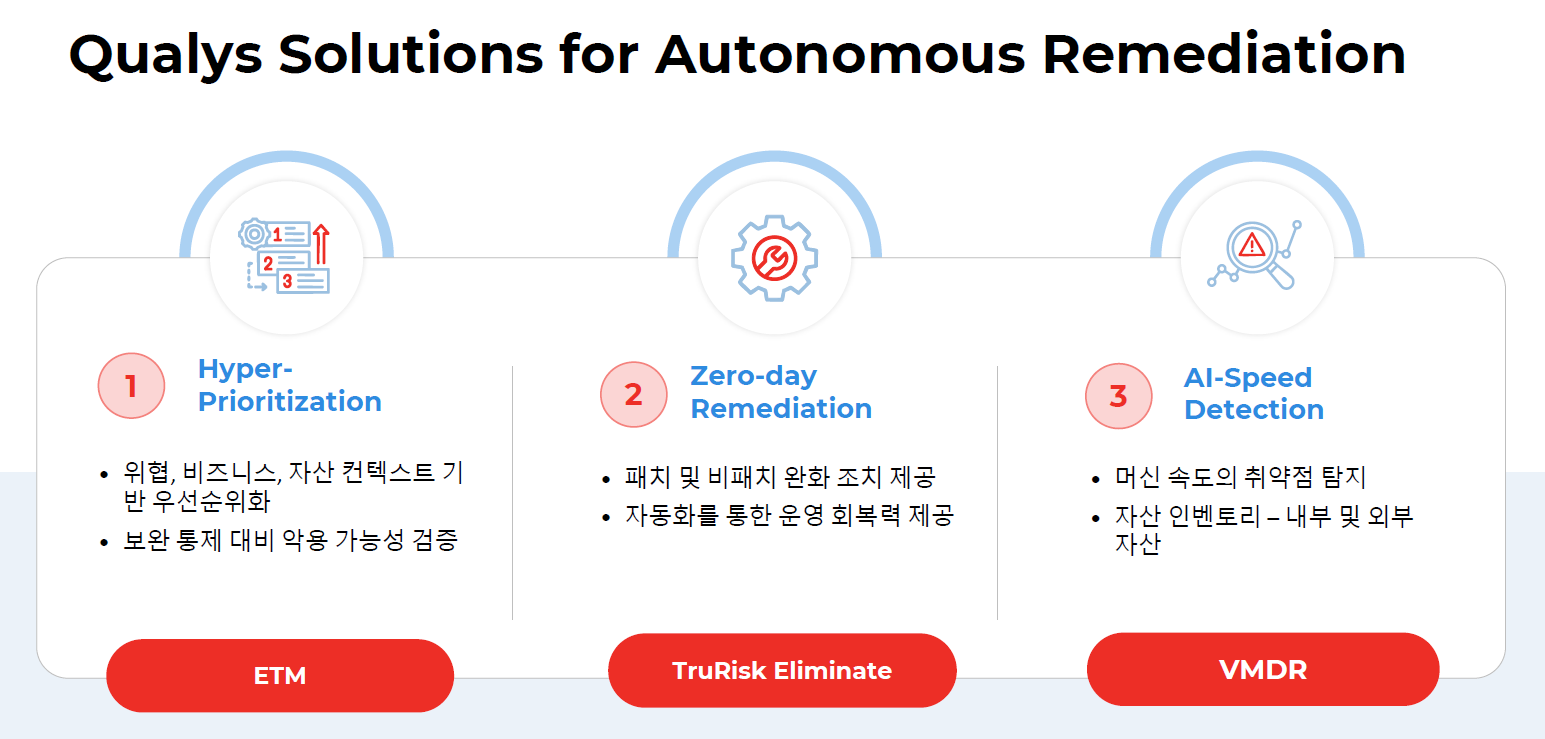
The core value and key capabilities of the three solutions are shown below.
| Category | VMDR | ETM | TruRisk Eliminate |
| Core Strategy | AI-Speed Detection | Hyper-Prioritization | Zero-day Remediation |
| Core Value |
|
|
|
| Key Capabilities |
|
|
|
☑️Conclusion
In the post-Mythos era, what security teams need is not more alerts. They need a framework that can determine what is truly risky and remediate faster than attackers.
Qualys autonomizes this entire process by integrating Hyper-Prioritization, Zero-day Remediation, and AI-Speed Detection within a single platform. It cuts through the noise of tens of thousands of vulnerabilities to focus only on what is truly risky, responds to zero-days regardless of whether a patch is available, and detects threats faster than competing solutions. Only when these three strategies are seamlessly connected is a security operations framework complete that can keep pace with attackers.
As AI changes the threat landscape, the way security operations are run must change accordingly.
As an official Qualys partner, CloudNetworks works together with customers on their cyber risk management. For detailed product information and inquiries, please visit the link below.
▶ Qualys Learn More