

Since the arrival of ChatGPT democratized access to generative AI, the enterprise environment has been changing rapidly. As AI becomes deeply integrated into everyday business operations, new types of risk have emerged that traditional security controls cannot address. Organizations face a variety of AI-related risks, including data compromise, third-party risks, and inaccurate or unwanted AI outputs. In particular, problems caused by internal employees' policy violations, oversharing of information, and misuse of AI occur far more frequently than malicious hacking.
Against this backdrop, Gartner published the "Market Guide for AI Trust, Risk and Security Management" in February 2025, presenting "AI TRiSM" as a systematic approach for enterprises to implement safe and trustworthy AI.
☑️What Is AI TRiSM?
AI TRiSM (AI Trust, Risk and Security Management) is a comprehensive technology framework for managing the trust, risk, and security of AI.
Its core goal is to ensure that AI complies with corporate policies and to deliver AI governance, trustworthiness, fairness, safety, security, privacy, and data protection. It does not refer only to technical solutions but encompasses a governance framework that integrates people, processes, and technology. AI TRiSM applies to all types of AI, from embedded AI to in-house agentic AI systems, and complements traditional technical safeguards.
☑️Defining the AI TRiSM Market
Gartner defines the AI TRiSM market as "four layers of technical capabilities that support enterprise policies for all AI use cases." These policies aim to ensure AI governance, trustworthiness, fairness, safety, reliability, security, privacy, and data protection.
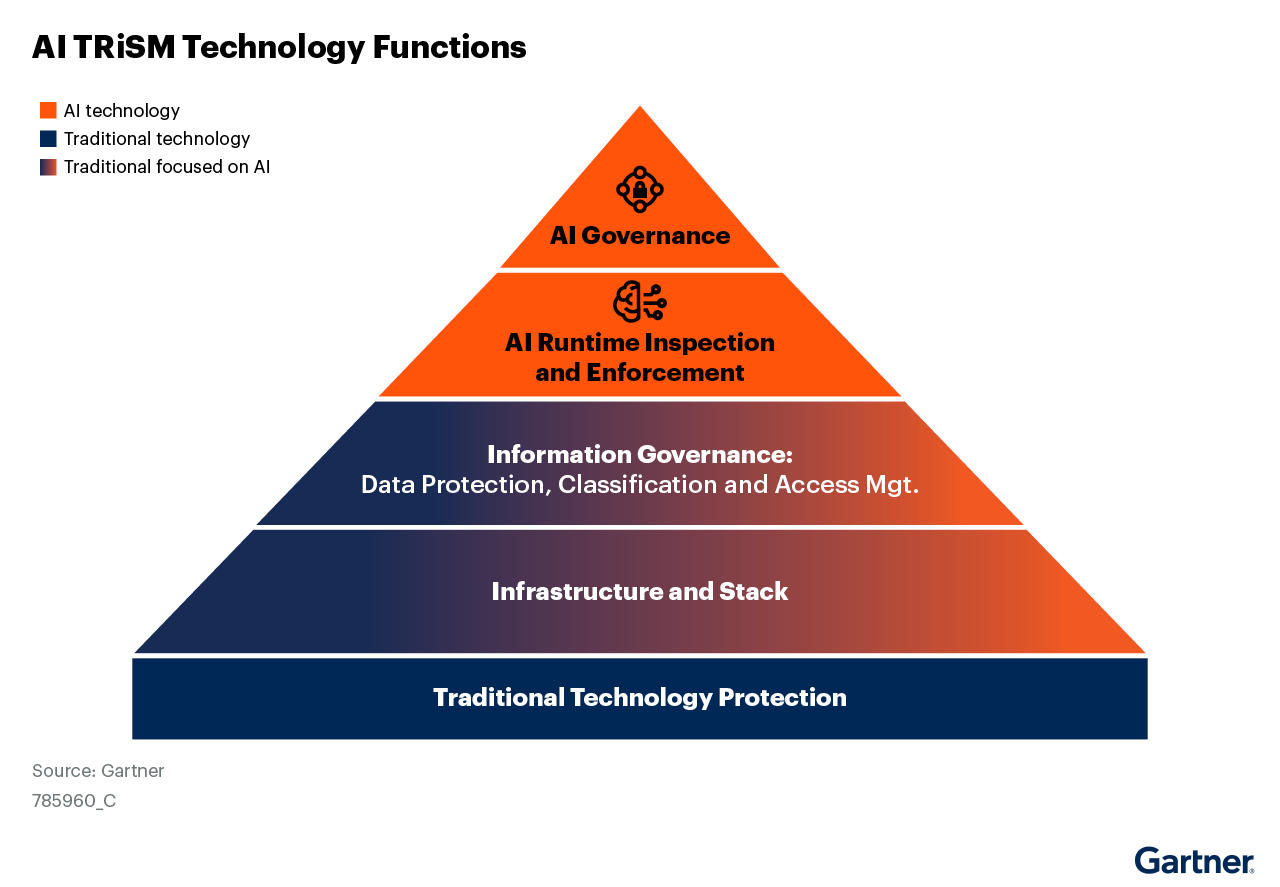
The top two layers, AI Governance and AI Runtime Inspection and Enforcement, are areas newly emerging for AI and are currently consolidating into a single independent market segment. The bottom two layers represent traditional technologies focused on AI.
☑️Key AI Risks Facing Enterprises
According to the report, the three AI risks enterprises are most concerned about are as follows.
Interestingly, it is predicted that by 2026, at least 80% of unauthorized AI transactions will be caused by internal policy violations concerning information oversharing, unacceptable use, or misguided AI behavior rather than by malicious attacks. While malicious hacking remains rare, cases of unconstrained harmful chatbots and internal data oversharing breaches are widespread.
This suggests that the focus of AI security must shift from defending against external attacks to managing internal policy compliance and appropriate use.
☑️Gartner's Key Predictions
Gartner offers the following specific outlook for the future of the AI TRiSM market.
2026: Internal policy violations become the main threat At least 80% of unauthorized AI transactions are expected to result not from malicious attacks but from internal policy violations such as information oversharing, unacceptable use, and misguided AI behavior
2027: Formation of the AI TRiSM services market AI TRiSM as a Service will emerge as a viable outsourced service option for enterprises that lack the resources to implement their own AI TRiSM services
2028: Spread of integrated governance teams 25% of large organizations will have integrated, dedicated information governance teams made up of data and analytics, digital workplace, security, and compliance staff (up from less than 1% in 2023)
These predictions show that AI TRiSM is an area that goes beyond simple technical solutions and requires fundamental changes in organizational structure and ways of operating.
☑️The Four-Layer Technology Structure of AI TRiSM
AI TRiSM technology consists of four layers built on top of traditional technology controls (network, endpoint, and cloud security solutions).
1. AI Governance
AI governance provides a framework for managing an organization's AI assets, building trust in AI performance, and ensuring business outcomes. Its key capabilities are as follows.
2. AI Runtime Inspection and Enforcement
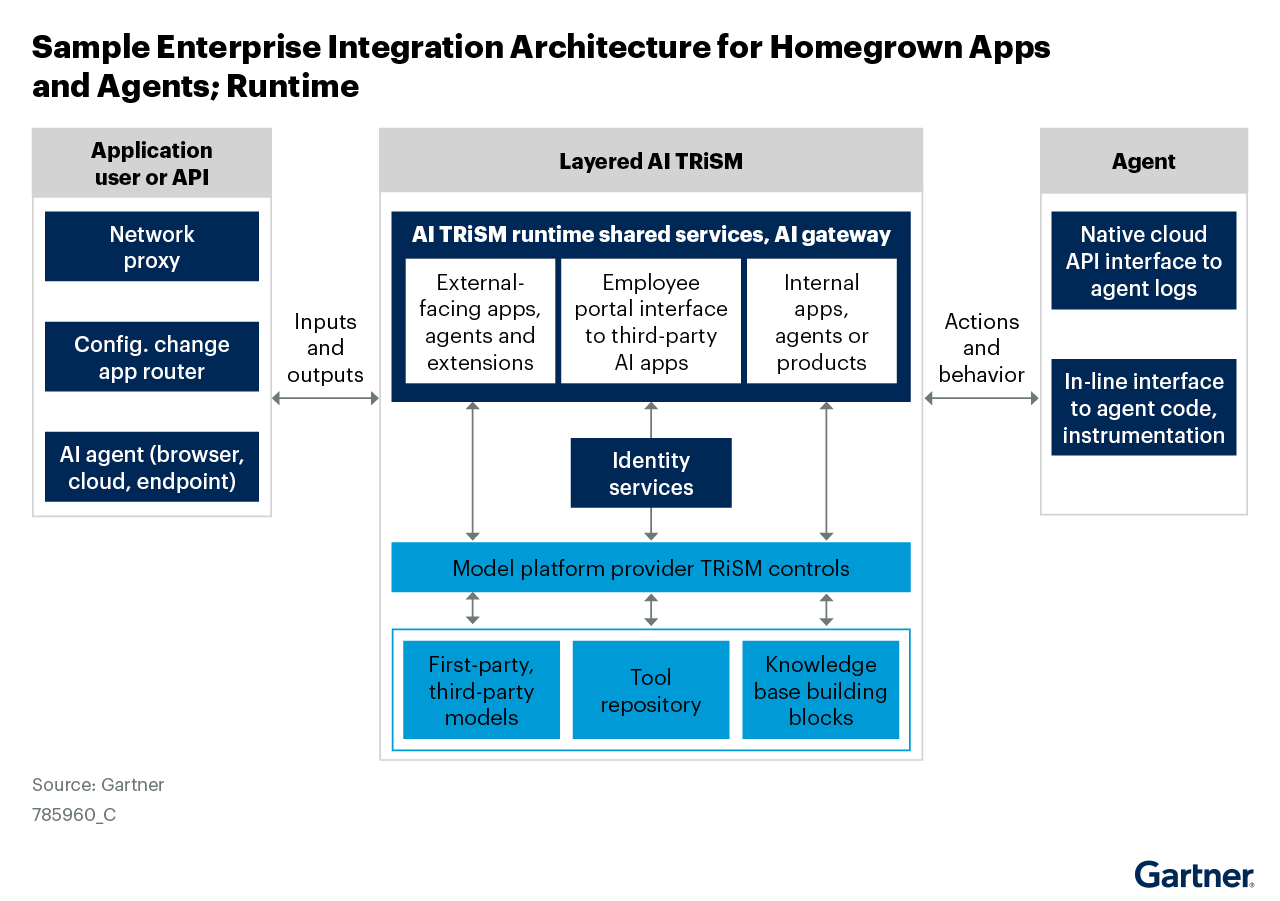
This layer is applied to model, application, and agent interactions to support the alignment of transactions with the organization's governance policies. It inspects relevant connections, processes, communications, inputs, and outputs for violations of policies and expected behavior. Anomalies are highlighted and blocked, automatically remediated, or forwarded to humans or incident response systems for investigation, triage, response, and applicable remediation.
Runtime controls for AI models:
Runtime controls for AI applications:
Runtime controls for AI agents:
3. Information Governance
In the context of AI TRiSM, information governance relates to the classification, protection, security, and management of data across its entire lifecycle. Mature information governance controls are essential to:
When generative AI tools are embedded in enterprise applications or use RAG to find organizational information, they can expose overshared data to a larger audience much faster, shining a light on data lifecycle problems. If appropriate measures are not taken to identify and manage sensitive data across the organization's data estate, these problems can worsen, creating unnecessary data risk and potentially leading to widespread data breaches.
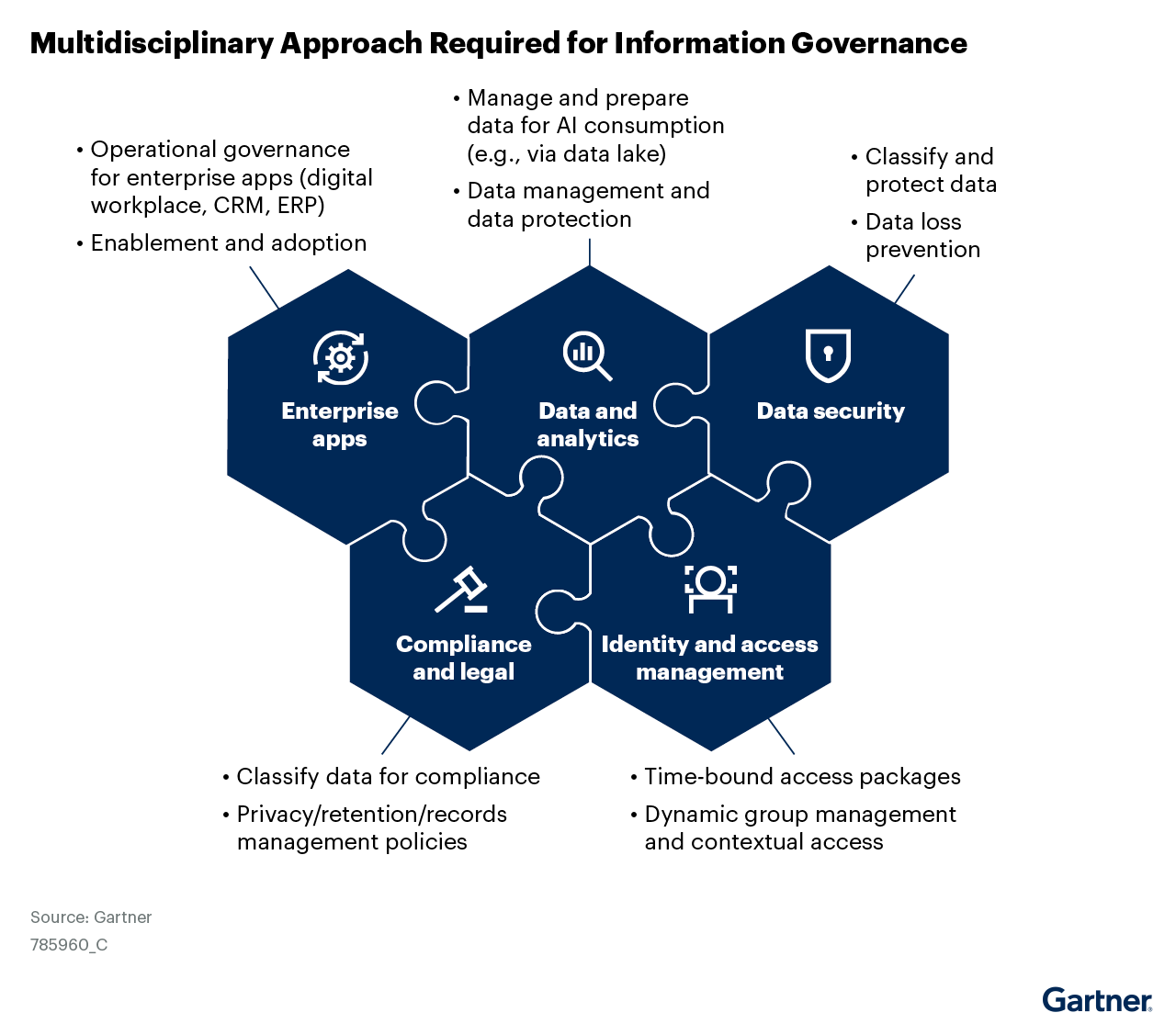
To improve information governance, organizations should form a multidisciplinary team made up of stakeholders from various teams, including digital workplace, data and analytics, data security, compliance, and IAM (Identity and Access Management). This team should focus on:
Currently, this technology layer remains fragmented among vendors that typically focus on one or two of the components required for comprehensive information governance. For example:
4. Infrastructure and Stack
Infrastructure and stack refers to the hardware and software environments that support AI workloads, the purpose-built tools and libraries used to develop and maintain AI applications, the data processing layer, and the deployment environment, including network infrastructure. Solutions in this category include API key management and confidential computing to protect workloads in trusted execution environments.
☑️Four Key Trends Shaping the AI TRiSM Market
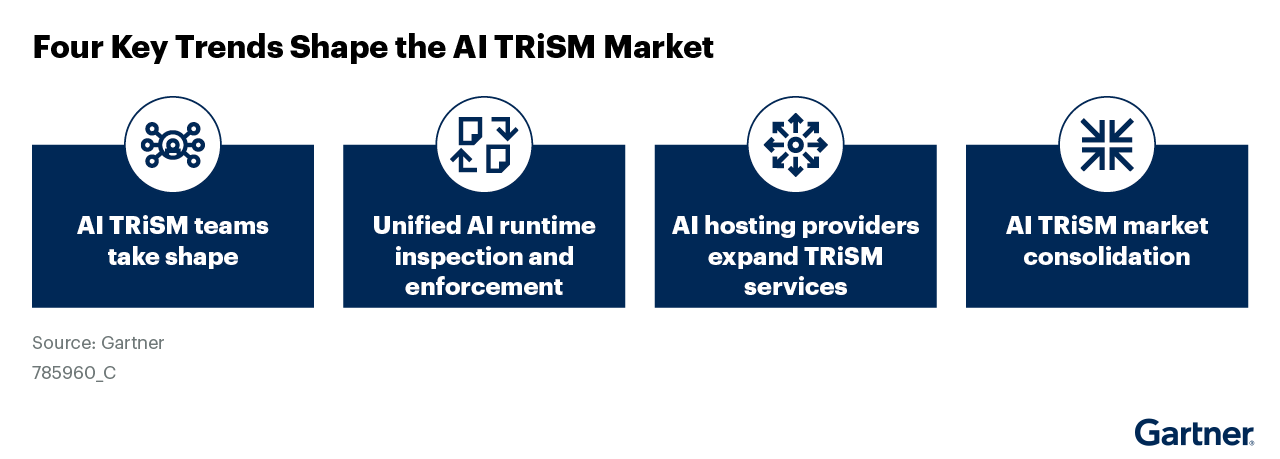
1. The Formation of AI TRiSM Teams
AI requires new cross-enterprise team processes and tools for effective runtime deployment. Gartner is seeing four new organizational trends that will naturally lead to TRiSM oversight and operations teams over the next three years.
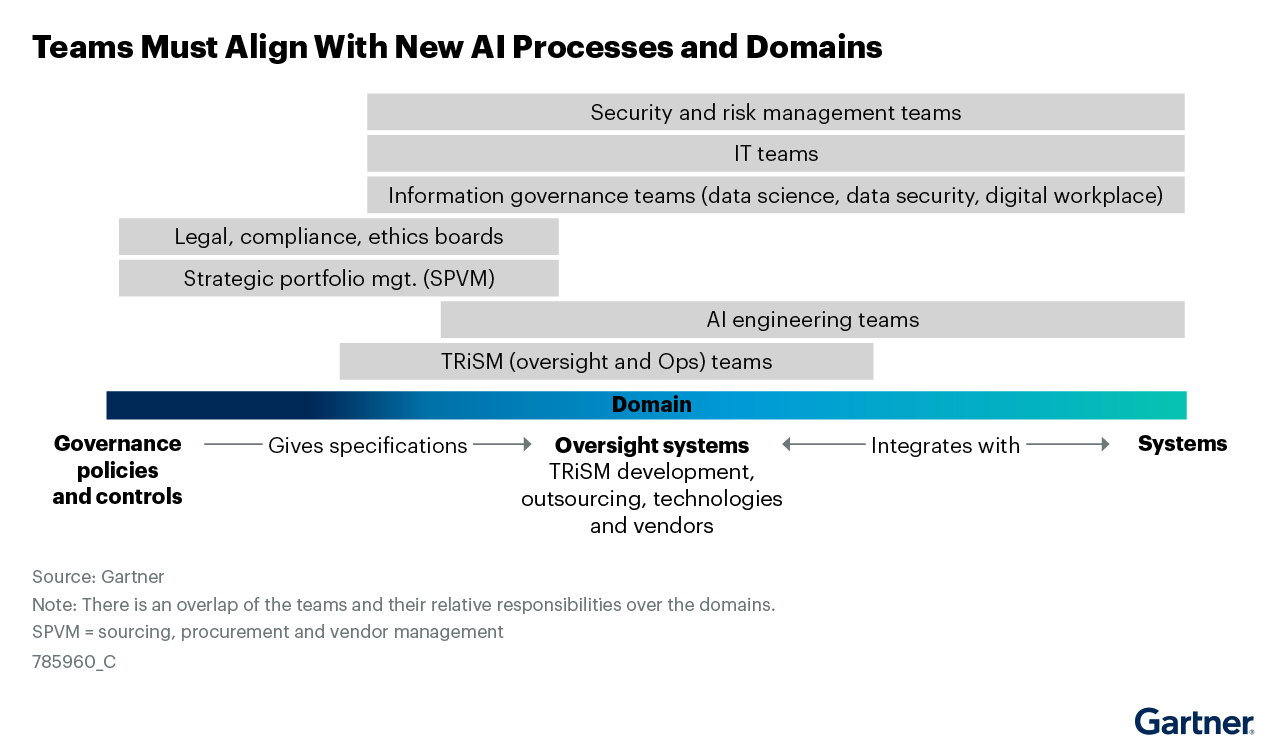
Gartner expects AI TRiSM oversight and operations teams to report to the managers responsible for enterprise AI innovation, development, and operations. Meanwhile, according to Gartner's 2024 enterprise AI survey, budget authority for AI privacy, security, and risk initiatives typically resides in the office of the CTO or CIO.
2. Unified AI Runtime Inspection and Enforcement Systems
Consistent signals, low latency, single-pass processing, and a unified runtime control system are needed to effectively handle runtime inspection of AI events and enforce enterprise policies. Otherwise, siloed inspection and policy enforcement systems for the same event at runtime will result in conflicting analyses and resolutions.
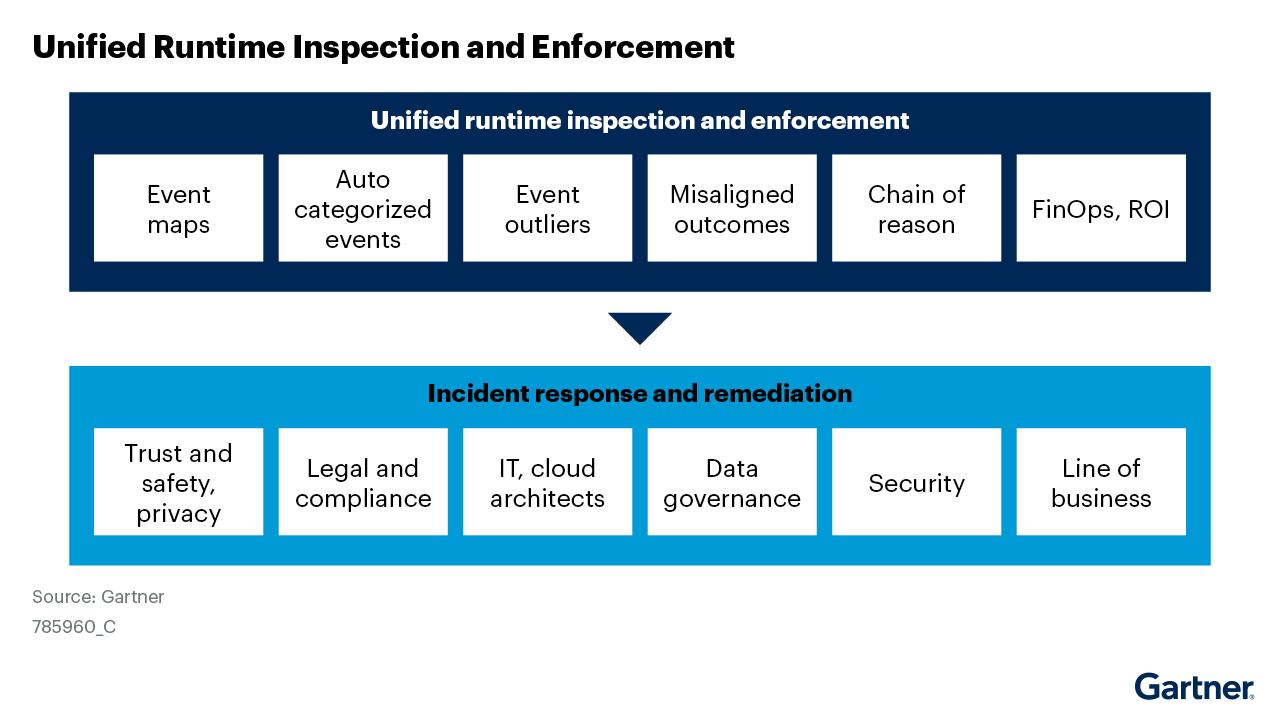
The following are important.
Organizations need to identify which team is best suited to manage the unified runtime inspection and enforcement system: a new AI team in AI engineering, an expanded IT team, or an expanded security and risk team. Regardless of who owns the unified runtime detection and enforcement system, incident response and remediation for suspicious transactions that are not automatically blocked or remediated should be forwarded to the unit and system best suited to handle them.
For example, in most scenarios, security events detected by the unified inspection and enforcement system are sent to the organization's SIEM team (or an appropriately outsourced managed security service provider) for necessary follow-up. AI event triage then requires multiple escalation queues depending on the type of anomaly or violation that occurred.
3. AI Hosting Providers Expanding TRiSM Services
Frontier model providers and other AI hosting providers are continuously expanding the TRiSM services they offer to enterprises as a competitive strategy to win more business. Some have already introduced tools that enterprises can use to support their own specific acceptable use policies. Most hosting providers have implemented guardrails on model use regarding violence, self-harm, sexual content, and hate. Many providers have implemented tools to detect known runtime security threats such as copyright infringement and prompt injection.
AI TRiSM will always be a shared responsibility between users and model providers, with the level varying depending on the configuration of the AI service, that is, whether it represents an IaaS, PaaS, or SaaS service. Organizations that host and manage their own models bear full responsibility for all risk mitigation.
4. Consolidation of the AI TRiSM Market
Integration of AI governance and AI runtime inspection and enforcement: This has already been partially achieved by several vendors in this Market Guide, and this trend is expected to accelerate after 2025. Vendors that provide AI runtime inspection and enforcement typically also provide two AI governance capabilities:
Integrating these two governance capabilities with runtime controls provides the foundation for real-time analysis and policy enforcement for all enterprise AI interactions and delivers a complete view of AI risks and threats.
Expansion strategies from multiple types of vendors: The integration of AI governance with runtime inspection and enforcement will be incorporated into services offered by established large software, security, or networking vendors seeking to increase their share of customer wallet by supporting users on their AI journey. For example:
Furthermore:
Consolidation of the information governance layer: Vendors offering DSPM, data security, and DLP systems will continue to expand to incorporate AI-centric capabilities. In particular:
☑️Recommendations for Enterprises
Gartner emphasizes that AI leaders must work with stakeholders across the organization to manage AI trust, risk, and security. They must establish an organizational structure to create and update AI governance policies and to evaluate and implement the AI TRiSM technologies that enable and enforce these policies.
Once organized, AI leaders and business partners should:
☑️Outlook and Implications
Gartner predicts that by 2028, 25% of large organizations will have integrated, dedicated information governance teams made up of data and analytics, digital workplace, security, and compliance staff. It also expects that by 2027, AI TRiSM as a Service will emerge as a viable outsourced service option for enterprises that lack the resources to implement their own AI TRiSM services.
AI TRiSM goes beyond technical solutions, exposing organizational silos and pushing teams to realign to solve problems across departmental boundaries. While no single vendor or solution currently addresses every aspect of AI threats and risks, the market is maturing rapidly and user demand is steadily increasing.
For enterprises to use AI safely and reliably, they need to understand the four-layer framework of AI TRiSM and take a phased approach suited to their own organization's situation.
▶ Read the full Gartner report : Market Guide for AI Trust, Risk and Security Management
Governance in the AI era is no longer optional but essential. Together with its global partners, CloudNetworks supports enterprises in adopting AI safely. If you have any questions about AI governance solutions, please feel free to contact us.