

In the AI era, cloud costs have become directly tied to business competitiveness. Any organization running Kubernetes has probably asked itself at some point: "Are we really using the cloud effectively?" Most cloud cost management solutions stop at showing the current state and making recommendations.
Cast AI goes a step further. It is a platform that autonomously analyzes and directly optimizes cloud resources without human intervention. This article looks at the value Cast AI provides in each of three areas: Kubernetes, databases, and GPU infrastructure.
The Problem That Started Cast AI
Five years ago, Cast AI asked a single question: "Are we really using the cloud effectively?"
According to the 2025 Kubernetes Cost Benchmark Report published by Cast AI, of the compute resources organizations provision in Kubernetes environments, only an average of 10% of CPU and 23% of memory is actually used. Most resources go unused while still generating costs.
This problem is not simply the result of misconfiguration. Developers tend to secure ample resources to guarantee application availability, and as clusters grow, manually optimizing resources hits structural limits. The spread of AI workloads has made this problem even more serious. GPU instance prices are highly volatile, and on AWS, a single NVIDIA H100 instance costs about $5,000 per month. Without efficient management, an organization's cloud cost burden can grow to an unmanageable level.
Cast AI's mission is to solve this problem: "to make the cloud more efficient."
Cast AI implements this through a concept called Application Performance Automation (APA).
How It Differs from Existing Solutions
There are already many cloud cost management solutions on the market. Cast AI pinpoints three limitations these solutions share.
Cloud cost dashboards show waste but do not fix it. Monitoring platforms send alerts but do not take action. Rightsizing tools suggest changes, but people have to carry them out.
Cast AI aims not merely to manage costs but to automate them, not to stop at showing inefficiencies but to fix them directly, and to turn Kubernetes from something to be tuned into a system that operates autonomously. A machine learning engine trained on thousands of clusters and real workload data analyzes clusters in real time and optimizes them automatically, resolving millions of possible scenarios through autonomous automation. Customers can see the scale of their savings for themselves within minutes of adoption.
Kubernetes Optimization: Reducing Cloud Costs Autonomously
This is Cast AI's core product area. By fully automating compute resource management for Kubernetes clusters, it reduces compute costs by 30 to 60% or more while also improving performance and stability. It supports all cloud and on-premises environments, including AWS, Google Cloud, and Azure.
Cast AI's Kubernetes optimization works in three main ways.
Node AutoScaler automatically adds new nodes of the right size when pods are unschedulable and removes underutilized empty nodes. In particular, it uses machine learning to predict spot instance interruptions up to 30 minutes in advance and proactively moves workloads to stable instances in a way users do not notice. Spot instances cost less than on-demand instances, but many organizations hesitate to adopt them because they can be interrupted without notice. By predicting and responding to these interruptions in advance, Cast AI maximizes the cost efficiency of spot instances while also ensuring service stability.
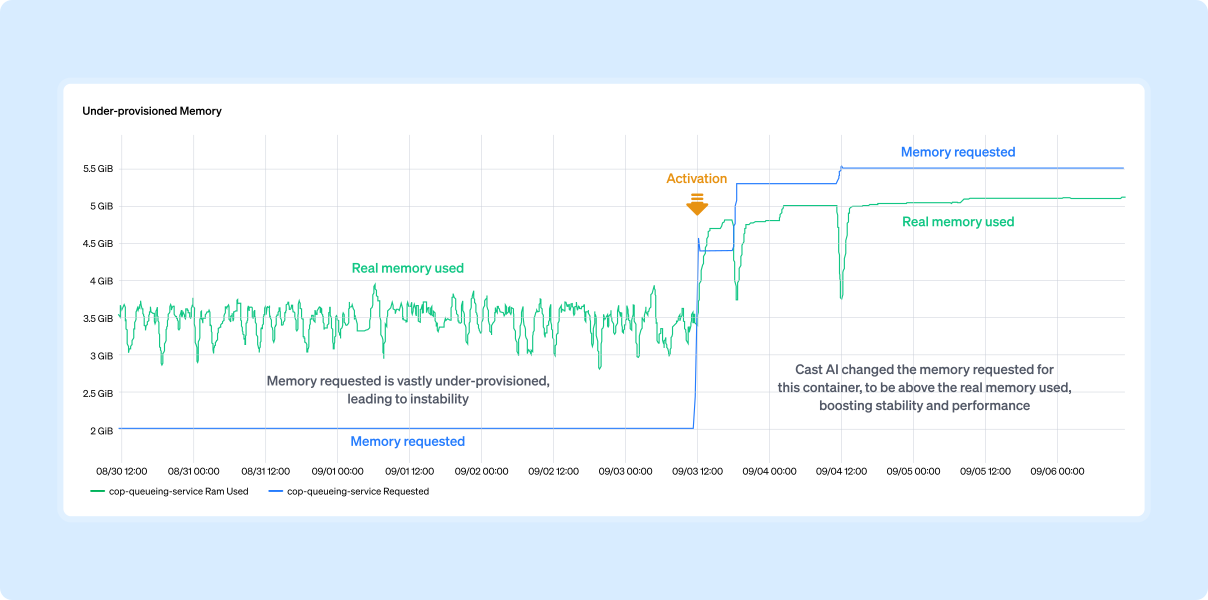
Workload Rightsizing (WOOP) automatically optimizes CPU and memory requests based on actual usage patterns. It adjusts workloads without service interruption, and with self-learning capabilities, once it is configured, the system makes its own decisions and optimizes from then on. The key point is that it solves both performance instability caused by underprovisioning and cost waste caused by overprovisioning at the same time. It also provides specialized handling for Java-based applications. Because the JVM reserves heap memory in advance at startup, the usage Kubernetes sees is always higher than actual usage. Cast AI applies a dedicated analysis method that accounts for this characteristic, enabling an additional 30 to 50% savings for Java workloads.
Rebalancer optimizes the node configuration of the entire cluster. Over time, clusters accumulate nodes with inefficiently distributed resources, and Rebalancer automatically detects them and replaces inefficient nodes with cost-efficient ones. Through bin packing, it places workloads efficiently on as few nodes as possible, reducing unnecessary nodes.
In addition, Cast AI offers a unique capability called Container Live Migration. Previously, it was virtually impossible to move stateful workloads, such as databases and AI/ML jobs that must maintain state, without downtime. These workloads had no choice but to keep running on expensive on-demand instances and remained a blind spot for cost optimization. By allowing these workloads to move freely without service interruption, Cast AI has extended the scope of automation to areas that could not be touched before. Going further, it became the world's first to implement in-flight workload rightsizing based on Kubernetes 1.33, achieving zero downtime by instantly adjusting CPU and memory without restarting pods.
In a real automotive manufacturer case, a 90% real-time reduction in cloud costs was confirmed after Cast AI was activated. Daily compute costs of around $750 before activation dropped to nearly zero after activation.
Database Optimization: Boosting DB Performance Without a Single Line of Code
Cast AI's Database Optimization (DBO) is a plug-and-play, fully autonomous database caching and optimization proxy. It delivers improved application performance, increased stability, and cost savings of at least 60% without any code changes.
Introducing caching to improve database performance typically requires three tasks: manually identifying the queries to cache, developing cache logic at the application level, and going through separate configuration work. As services grow, this complexity increases rapidly, and organizations often end up abandoning caching altogether or responding by adding more read replicas.
DBO fully automates this process. An AI engine analyzes data patterns to automatically identify and cache frequently accessed queries, and cached data is served instantly from the cache rather than the database. Because the number of queries reaching the database itself decreases, response times improve and database load decreases at the same time. It achieves up to 10x performance improvement, and because read replicas can be removed and database resources downscaled, cost savings follow as well. It currently supports PostgreSQL and MySQL on AWS, Google Cloud, and Azure.
In a real customer case, a 20 to 30% reduction in database load and a 30% reduction in CPU usage were confirmed immediately after Database Optimization was activated. In another case at a high-tech company, a cache hit rate of 76.49% was achieved immediately upon activation, meaning more than three-quarters of all read queries were served from the cache without reaching the database.
OMNI Compute: Using GPU Resources Across Cloud Boundaries
OMNI Compute is a unified compute control platform launched by Cast AI in January 2026 that enables compute resources, including GPUs, to be operated in an integrated way across cloud and region boundaries.
Organizations running AI workloads face common challenges. GPU shortages in their preferred regions delay AI initiatives, workloads are hard to move even when cheaper GPU providers are available, and building a multi-cloud environment involves enormous cost and complexity. The moment an organization becomes locked into a particular cloud or region, it also loses pricing leverage.
OMNI Compute solves this problem by managing GPU resources distributed across multiple clouds and regions as a single Kubernetes cluster. It automatically finds and provisions the cheapest GPU capacity not only across hyperscalers (AWS, Google Cloud, Azure) but also across neoclouds, and it can be used right away in existing Kubernetes clusters without code changes. For example, from a cluster in the AWS N. Virginia region, EC2 in Ohio, GCP VMs in Europe, and Oracle Cloud instances in the US Midwest can all be managed together as a single cluster.
Cast AI co-founder and President Laurent Gil explained that "OMNI Compute makes GPUs a general-purpose resource at the infrastructure layer, allowing compute capacity that was tied to a specific cloud or region to be used freely."
Conclusion
Cast AI is a platform that autonomously optimizes cloud infrastructure as a whole through Kubernetes optimization, database optimization, and OMNI Compute. The key point is that it does not merely show costs or make recommendations but analyzes cloud resources in real time and optimizes them directly without human intervention. Currently, about 2,100 organizations worldwide have adopted Cast AI and are realizing tangible cloud cost savings, and global companies across a variety of industries, including in Korea, are proving its impact in real production environments.
As an official Cast AI partner, CloudNetworks supports the entire Cast AI adoption process for enterprise customers in Korea, from cost optimization of Kubernetes environments to database performance improvement and GPU infrastructure operations. If you are considering adoption or have any questions, please feel free to contact us.
▶ Cast AI Learn More