

As enterprise AI adoption moves beyond experimentation and becomes connected to real business systems and decision-making, the focus is shifting from "how to adopt AI" to "how to operate adopted AI securely." The more generative AI and AI agents are connected to internal data and external tools, the greater the risks of incorrect outputs, data leakage, and privilege misuse. The regulatory environment is moving in the same direction. With the AI Basic Act taking effect in January 2026 and the "Financial Sector AI Guidelines" in June, the direction is becoming clear: organizations may use AI, but must have corresponding controls in place.
This article briefly explains what AI security governance is and then covers the two frameworks that put it into practice. The first is a lifecycle that cycles through the entire process of adopting and operating AI services, and the second is a runtime control flow that operates the moment a user calls AI.
☑️ What Is AI Security Governance?
AI security governance is an operational framework that identifies and controls security threats from the adoption of AI services through operation and retirement, while managing output quality, resources, and costs under a single standard. To understand it, we first need to look at the broader concept of AI governance. AI governance is the full set of policies and processes that ensure AI complies with corporate policies, ethical standards, and regulatory requirements, including inventorying AI assets, assessing and approving risks, ensuring auditability and traceability, and managing regulatory compliance. Gartner structures this through the AI TRiSM (Trust, Risk and Security Management) framework, defining four layers: the AI governance layer, which handles policy; the runtime inspection and enforcement layer, which inspects and blocks interactions at execution time; the information governance layer, which protects data; and the infrastructure and stack security layer, where AI workloads run.
In its 2025 AI TRiSM Market Guide, Gartner analyzed that the top two of these layers, AI governance and runtime inspection and enforcement, are emerging as areas newly required for AI and establishing themselves as a distinct market. The fact that the runtime inspection and enforcement layer is emerging alongside the governance layer that handles policy shows that governance is not complete with policy declarations alone. For the top policy layer to actually work, runtime controls, data protection, and infrastructure security beneath it must function together. AI security governance is a framework focused on exactly this point, implementing policies as real security and operational controls, and its core lies in continuously cycling through the stages of discovery, assessment, control, monitoring, and governance rather than performing one-off checks.
☑️ Why AI Security Governance Matters Now
There are three reasons AI security governance is drawing attention.
First, regulation has entered the enforcement stage. The AI Basic Act took effect on January 22, 2026, and certain provisions of the amended act are scheduled to take effect on July 21, 2026, together with the enforcement decree. Ahead of this, the Ministry of Science and ICT announced the proposed amendment to the enforcement decree in May 2026. The act sets out obligations such as ensuring transparency and safety and providing advance notice for products and services that use high-impact AI and generative AI. Organizations need to review whether their AI services fall within this scope and prepare their governance by establishing impact assessment and record-keeping and management systems. In the financial sector, the "Financial Sector AI Guidelines," which took effect on June 22, 2026, present seven principles for AI use, including governance and security, as self-regulation, and the "Financial Sector AI Security Guide," which details the security principle, was distributed alongside them, making industry-specific operational standards increasingly concrete.
Second, the emergence of AI agents has changed the nature of threats. As AI begins to plan on its own, call tools, and collaborate with other agents, attack surfaces have emerged that are difficult to address with traditional application security. OWASP has organized these into the OWASP Top 10 for Agentic Applications for 2026, presenting ten risks including Agent Goal Hijack, Tool Misuse, Identity & Privilege Abuse, Memory & Context Poisoning, and Insecure Inter-Agent Communication. Because of agent autonomy, these threats can be exploited at scale without human intervention, requiring both pre-deployment assessment and runtime controls.
Third, perimeter defense alone has its limits. Network separation is effective at blocking external intrusion by separating external and internal networks, but it cannot prevent risks posed by elements that are already inside and operating autonomously, such as AI agents. Parallel execution of large volumes of transactions and automated propagation can occur even within physical boundaries. Because perimeter defense alone is not enough, governance that addresses AI operations themselves has become necessary.
☑️ The AI Security Governance Lifecycle: Discover → Assess → Control → Monitor → Govern
AI security governance does not end with a single check; it operates as a cyclical framework that repeats five stages. The final Govern stage feeds back into the first Discover stage, gradually raising AI security maturity.
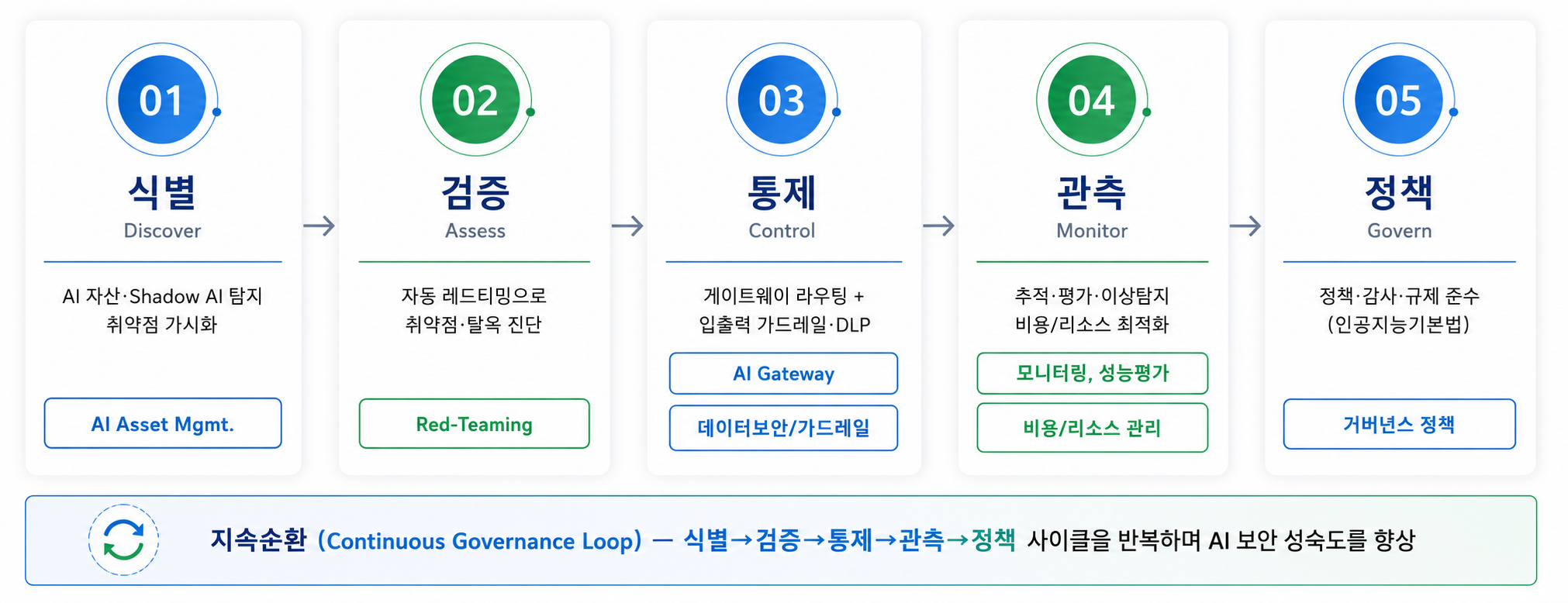
First, the Discover stage. It detects which AI assets the organization is using and where, identifies any Shadow AI being used without approval, and makes vulnerabilities visible. Without knowing what needs to be protected and what the current risks are, subsequent controls are impossible, so understanding the current state of assets and risks is the prerequisite for all controls.
Second, the Assess stage. Before the identified AI models and agents are put into operation, it simulates attacks that use manipulated queries to induce incorrect answers or actions, diagnosing vulnerabilities and the potential for bypass (jailbreak). Using the OWASP agent threat categories mentioned above as assessment criteria, this stage filters out issues before deployment through automated Red Team testing.
Third, the Control stage. At runtime, when AI services actually send and receive requests, it authenticates and routes traffic and applies guardrails to inputs and outputs to block prompt injection and sensitive data leakage. This stage controls in real time who accesses which AI and what is exchanged, and the order in which these controls operate in the actual request flow is examined in detail in the control flow section that follows.
Fourth, the Monitor stage. It traces the call flows of AI services in operation, evaluates outputs, and detects anomalies to verify that AI is producing trustworthy results. At the same time, it analyzes and optimizes resource usage and costs. Because AI workloads consume significant resources, performance and quality management and resource and cost management take place together within this single stage.
Fifth, the Govern stage. Based on the visibility and data gained in the previous stages, it establishes policies, ensures auditability and traceability, and manages the status of regulatory compliance, including the AI Basic Act. The policies and standards defined here are fed back into the scope and priorities of the Discover stage, making governance not a one-off project but a continuously maturing framework.
☑️ Security Control Flow During AI Use: Input → Processing → Output
The control flow is how the Control and Monitor stages described above actually unfold with every user request. From the moment a user request reaches an AI service until a response is returned, controls are applied in order along the sequence from input to processing to output.
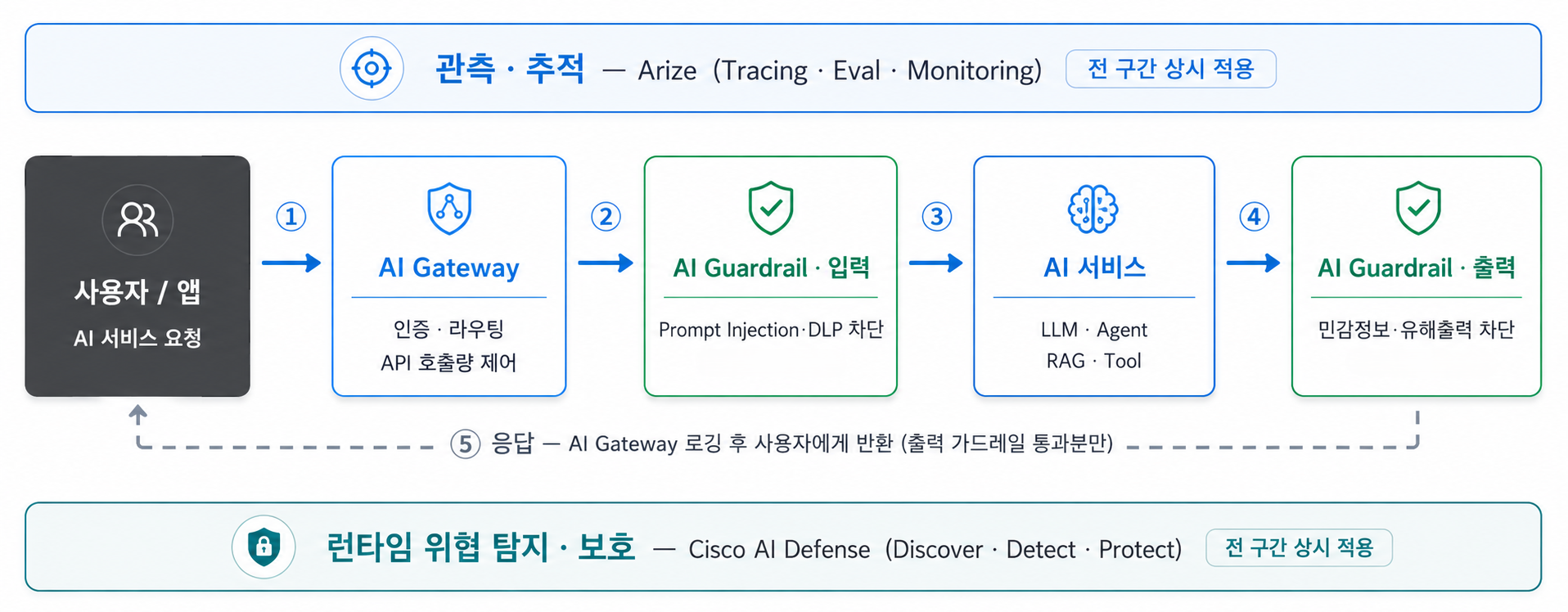
A request first passes through the gateway. Authentication, routing, and rate limiting are applied here. It is the access control point that decides which request goes to which model and filters out abnormally high call volumes.
Requests that pass the gateway then meet the input-side guardrail. It checks for prompt injection attempts and sensitive information, blocking risky inputs from being passed directly to the AI service. Only requests that pass here enter the AI service and go through the LLM, agents, RAG, and external tool calls to generate a response.
The generated response is not delivered immediately but passes through the output-side guardrail once more. It checks that no sensitive information or harmful output is included, and only responses that pass are logged through the gateway and returned to the user. The reason for placing the same checks on both input and output is that the path through which risk enters and the path through which it leaks out are different.
Observability and tracing are applied continuously across the entire input, processing, and output path. Call flows are traced and results are evaluated and monitored so that, when a problem occurs, it is possible to pinpoint where it originated. Runtime threat detection and protection for assets and vulnerabilities also operate across the entire path. Regardless of which products are used to implement each function, this is the basic framework of control points that any organization operating AI services should have in place.
☑️ How the Lifecycle and Control Flow Connect
The two frameworks implement the same principles on different time scales. The lifecycle operates over the long cycle of adopting and operating AI services, while the control flow operates over the short, second-by-second cycle in which users call AI.
The two work in tandem. The Control stage of the lifecycle is implemented as the gateway and guardrails of the control flow, and the Monitor stage is implemented as the continuous tracing and monitoring of the control flow. The Assess stage is applied in advance, at deployment, before the control flow begins, reducing the burden at runtime. There is also a flow in the opposite direction. Logs and anomaly signals accumulated with every request in the control flow feed back into the Monitor and Govern stages of the lifecycle, providing the basis for deciding what to discover and assess further in the next cycle. When the long and short cycles are connected in this way, AI security governance works as real operations rather than a declaration on paper.
☑️ Where to Start with AI Security Governance
AI security governance is not completed by adopting a single tool. It requires designing the lifecycle and control flow to fit the organization's AI environment and connecting the capabilities needed at each stage.
In most cases, starting with the Discover stage is effective. The approach is to first make visible which AI assets the organization is using and where the risks lie, and then expand the scope to Assess, Control, Monitor, and Govern. Rather than trying to establish all five stages from the start, setting priorities based on which stage holds the most urgent risks can reduce the burden. In highly regulated environments such as finance, manufacturing, and the public sector, it is especially important to adjust the scope and sequence to the regulatory requirements of that environment.
☑️ Frequently Asked Questions
How is AI security governance different from traditional information security?
While traditional information security focuses on blocking external intrusion and perimeter defense, AI security governance addresses the risks unique to AI services across their entire lifecycle, from AI asset discovery to pre-deployment assessment, runtime input and output control, monitoring of output quality and costs, and governance. Another difference is that it manages not only security but also the quality of AI outputs and resources and costs within the same framework.
What stages make up the AI security governance lifecycle?
It consists of five stages: Discover, Assess, Control, Monitor, and Govern. It is a continuous framework that discovers assets and threats, assesses vulnerabilities before deployment, controls at runtime, monitors outputs and costs during operation, and then formalizes them into policies that cycle back to the Discover stage.
What is the difference between the lifecycle and the control flow?
The lifecycle is a long-cycle management framework for adopting and operating AI services, while the control flow is a short-unit runtime control that operates every time a user calls AI. The Control and Monitor stages of the lifecycle are implemented as the gateway, guardrails, and monitoring of the control flow, and the data accumulated in the control flow feeds back into the lifecycle, so the two work in tandem.
How does the AI Basic Act affect AI operations?
The AI Basic Act took effect on January 22, 2026, and certain provisions of the amended act are scheduled to take effect on July 21, 2026, together with the enforcement decree. Because it sets out obligations such as ensuring transparency and safety and providing advance notice for products and services that use high-impact AI and generative AI, organizations need to review whether their AI services fall within its scope and manage their compliance status in the Govern stage of governance. In the financial sector, industry-specific standards such as the "Financial Sector AI Guidelines," which took effect on June 22, 2026, and the "Financial Sector AI Security Guide" should also be reviewed. (This reflects the time of writing, and the specific details of subordinate regulations and guidelines should be checked on an ongoing basis.)
What security threats require particular attention in AI agent environments?
The OWASP Top 10 for Agentic Applications for 2026 identifies Agent Goal Hijack, Tool Misuse, Identity & Privilege Abuse, Memory & Context Poisoning, and Insecure Inter-Agent Communication, among others, as key threats. Because of agent autonomy, these threats can be exploited at scale without human intervention, making it important to have both pre-deployment assessment and runtime controls in place.
☑️ Conclusion
The core of AI security governance lies in making two cycles work in tandem. The lifecycle, which runs through Discover, Assess, Control, Monitor, and Govern, sets the overall framework for operations, and the control flow, which runs through input, processing, and output, executes those principles with every request. When these two cycles are connected, AI services can deliver trustworthy results securely.
CloudNetworks supports the process of designing an AI security governance lifecycle and control flow tailored to each customer's environment, from asset discovery and pre-deployment assessment to gateway- and guardrail-based runtime control, monitoring of output quality and costs, and policy development for regulatory compliance. For more information on adopting and operating AI security governance, please contact CloudNetworks.
[Source : National Law Information Center, "Framework Act on the Development of Artificial Intelligence and Establishment of Trust", Ministry of Science and ICT, "Legislative Notice of the Proposed Amendment to the Enforcement Decree of the AI Basic Act to Strengthen AI Industry Promotion", Financial Services Commission, "Financial Sector AI Transformation (AX) Field Meeting Held and Proposed Amendment to the Financial Sector AI Guidelines Announced", Financial Security Institute, "Financial Sector AI Security Guide", OWASP, "OWASP Top 10 for Agentic Applications for 2026", Gartner, "Market Guide for AI Trust, Risk and Security Management (2025)"]