

Enterprise AI use cannot be summed up in one or two forms. Cloud AI services and GPUs, models running in containers, AI code in code repositories and development pipelines, generative AI features embedded in SaaS, AI tools used in the browser, and AI agents and MCP servers are all growing at the same time. Security leaders and compliance officers face four questions: Where is AI running? Is it safe from data leakage? What can AI agents access? Can you prove that controls are working?
Qualys TotalAI is a solution designed to answer these four questions. This article outlines the sequence in which TotalAI handles AI risk, the capabilities it provides, and how it connects with existing risk management frameworks.
☑️ What Qualys TotalAI Covers
Qualys TotalAI is an AI governance and risk management solution that unifies the discovery, assessment, remediation, and governance of AI assets in a single solution. It runs on the Qualys Enterprise TruRisk Platform and turns AI risk telemetry, from code to runtime, into evidence that controls are working.
The purpose of this solution is to address the governance gaps created by rapid AI adoption. Building a trusted AI inventory across the enterprise, assessing posture and behavior, prioritizing remediation, and producing audit-ready evidence are connected into a single process. This evidence accumulates not as one-off check results but as repeatable AI governance.
☑️ Four Stages of How Qualys TotalAI Handles AI Risk
TotalAI addresses AI risk in four stages: discover, assess, remediate, and report.
Discover : Eliminating Shadow AI Across the Enterprise
It discovers both sanctioned AI and shadow AI. Coverage includes cloud services, SaaS, GPUs, AI agents, models, MCP servers, hosts, containers, AI code, development pipelines, and browser-based AI. Beyond discovery, it fingerprints models, frameworks, and workloads, then maps each asset to its owner, operational context, exposure status, and access privileges to critical systems. The result is an inventory baseline that shows what is running, where it runs, who owns it, and whether it is sanctioned.
Assess : Posture Checks and Adversarial Testing
It uses AI-SPM and adversarial testing together to inspect the entire AI stack. It tests LLMs and MCP servers for prompt injection, jailbreaks, tool poisoning, and control failures, and adds eBPF runtime activity observation and pre-deployment shift-left scanning to identify risks at the pipeline code stage before deployment. It extends vulnerability management and posture management to AI assets and combines AI-specific testing with real-time monitoring to provide a 360-degree view of risk, with each finding accompanied by forensic evidence and a severity rating.
Remediate : Selecting What to Address First
It provides TruRisk-based prioritized remediation and guardrail recommendations. Items that are actually exploitable are addressed first, along with the rationale for why each item takes priority. Scoring reflects vulnerability severity, data sensitivity, asset criticality, business context, model behavior, and runtime evidence, and it correlates model exposure, identity privileges, and data sensitivity to reveal toxic combinations. Prioritized items, whether misconfigurations, exposed secrets, weak access policies, or failed model tests, are routed to the teams responsible for cloud, DevOps, AppSec, identity, and GRC. For high-impact AI risks, guides that walk through remediation steps are provided and can be used by both SecOps and MLOps. Once remediation is applied, retesting is performed and the results are recorded, closing the loop from detection to remediation, validation, and documentation, and leaving evidence that risk has been reduced.
Report : Turning Security Controls into Compliance Reports
It converts security control results into automated compliance evidence and vendor risk evidence. Without separate manual work, results are aligned to the NIST, EU AI Act, FISMA, OWASP LLM Top 10, MITRE ATLAS, and CMMC 2.0 frameworks. In the process, security questionnaire responses are simplified, and an audit-ready executive dashboard is generated that shows the applied AI guardrails are working.
☑️ Key Capabilities Across the AI Lifecycle
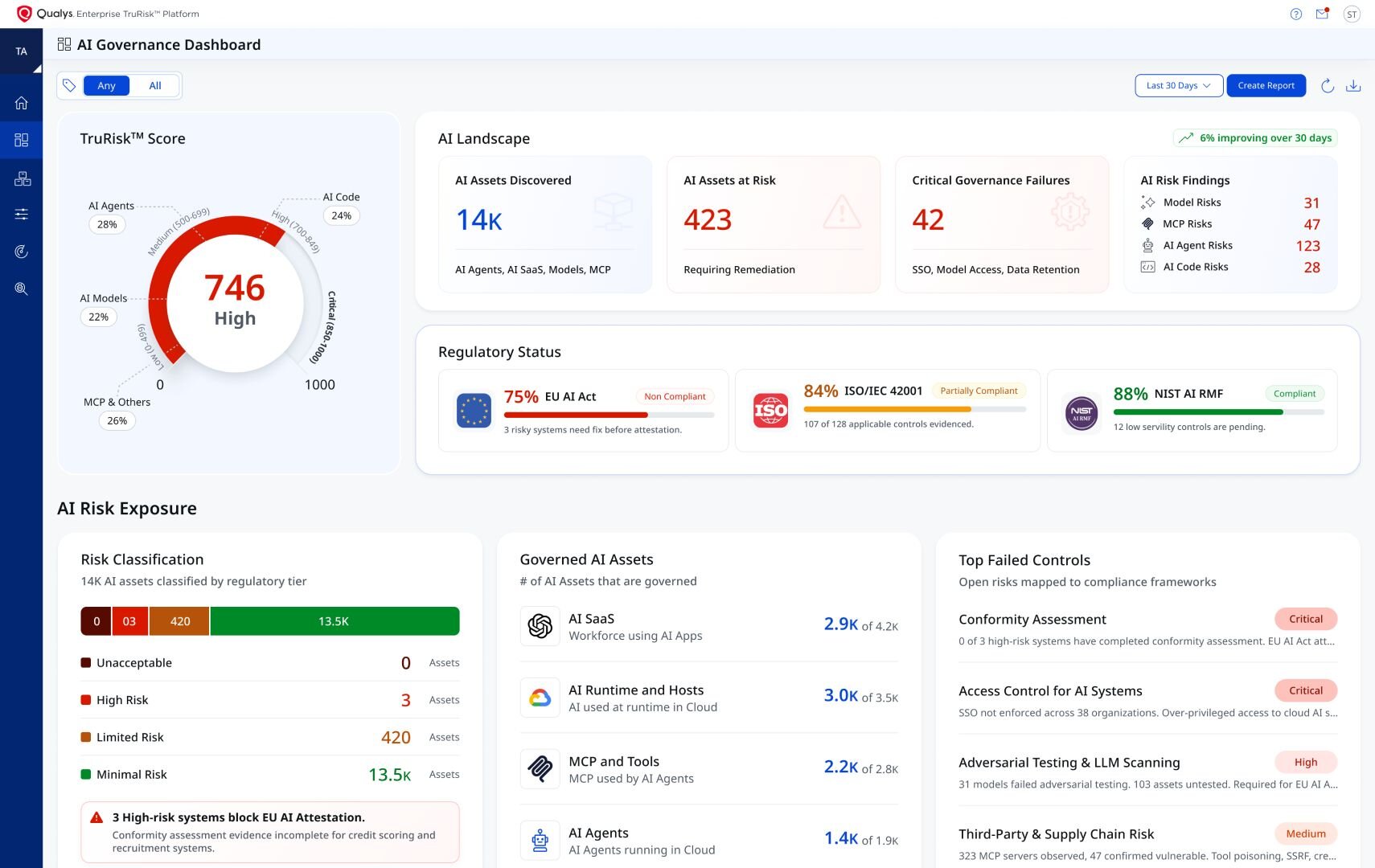
TotalAI converts risk telemetry collected across the AI lifecycle into evidence of control effectiveness and governance. It provides the following six capabilities.
AI Security Posture Management (AI-SPM)
It provides visibility into the full AI posture, including vulnerabilities, misconfigurations, and excessive access privileges. It correlates risks across models, agents, cloud services, and controls to present high-business-impact exposures and toxic combinations in prioritized form. Findings are organized by control. You can review failed security and governance controls, cloud misconfigurations, vulnerable AI infrastructure, excessive access privileges, exposed model or MCP endpoints, and missing safeguards item by item. Toxic combinations where privileges, sensitive data, exposure, and weak controls overlap are also revealed.
Managing Employee Generative AI and AI SaaS Usage
It identifies shadow AI and data leakage risks arising from employee browsers and embedded SaaS applications. It monitors prompt activity, tracks the movement of sensitive data, and assesses SaaS configurations to eliminate governance gaps. It identifies risky browser-based AI activity and evaluates the AI SaaS services used by the organization.
LLM Red Team Testing
It tests LLMs directly for prompt injection, jailbreaks, sensitive information disclosure, hallucinations, insecure output, multilingual and encoding attacks, denial of service, and multimodal manipulation. Scan reports are mapped to OWASP, MITRE ATLAS, and the EU AI Act, along with guardrail recommendations that can be applied before models go into production. The purpose of this capability is to run the same kinds of tests before attackers attempt them. Results go beyond a simple verdict. You can review the prompts used, model responses, severity, pass/fail verdicts, successful jailbreak cases, and the technical reasons controls failed.
MCP and Agentic AI Security
It discovers and scans MCP servers to inspect connections between AI agents and enterprise systems. It detects tool poisoning, argument injection, SSRF, DNS rebinding, rug pull attacks, insecure file access, spoofing, command execution, and credential exposure, providing visibility to prevent agents from performing unsafe actions. You can distinguish which MCP servers exist, what they expose, and which of those items could lead to risky agent behavior.
Agentic Application Governance
It covers the entire lifecycle of agentic AI, from code and authorization policies to workloads and runtime. It scans AI code, validates Cedar policies, and tracks agentic workloads and agents across hosts and containers. It combines eBPF kernel visibility with MCP monitoring to track agent behavior and verify privileges. Shift-left coverage, which identifies AI risks before code, containers, and policies reach production, is included in the same flow.
Post-Approval Monitoring
AI risk does not end at deployment. It continuously monitors model activity and runtime activity across hosts, containers, MCP servers, and browser-based AI usage, detecting posture drift, suspicious activity, and signs of data exfiltration. From testing through production, it produces real-time evidence that AI is operating within its approved scope.
Compliance and Audit Readiness
TotalAI is designed so that the evidence it produces can be used for three purposes. For regulatory compliance, it aligns audit-ready AI evidence with NIST AI RMF, the EU AI Act, the OWASP Top 10 for LLM, and MITRE ATLAS. For internal audit, it provides board-ready reports and traceable GRC audit records of AI risks and controls. For customer engagement, it reduces the burden of completing security questionnaires and enables vendor AI risk to be assessed based on technical evidence. The resulting evidence is used for customer security questionnaires, vendor assessments, board reporting, and regulatory reviews. Reports directly answer the questions auditors and executives ask: What AI systems do we have? Which of them are compliant? What