

As enterprise development teams increasingly adopt AI coding agents and inference workloads, a challenge has emerged alongside this growth: the more usage scales, the harder it becomes to predict and control costs. With the standard approach of calling external model APIs directly, it's difficult to see AI usage costs broken down by developer or team in advance, and organizations often end up using the same high-cost model regardless of the nature of the task. On top of this, in a structure where prompts and code are sent out to external model providers, data sovereignty concerns—data leaving the organization's boundary—also need to be considered.
Cast AI, a cloud-native and AI workload automation platform company, offers an AI coding and inference solution addressing these issues under the name Kimchi. This article summarizes the challenges Kimchi addresses and its key features.
☑️ What is Kimchi?
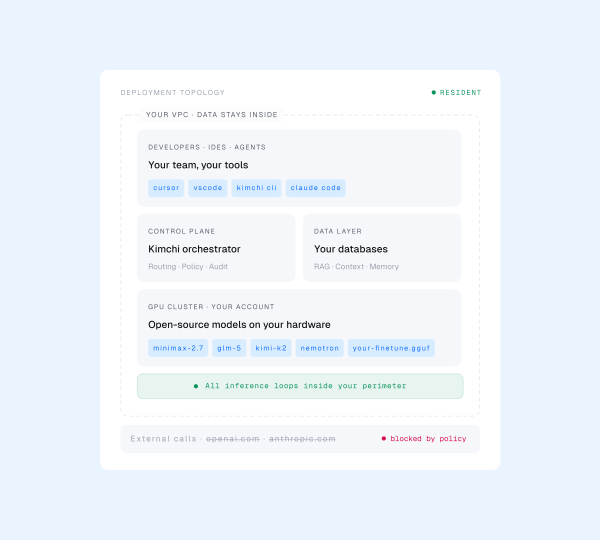
Kimchi is Cast AI's autonomous multi-model coding agent that runs open-source models inside the customer's own infrastructure while managing task-based model routing, governance, and cost control together. It functions as both a terminal-based coding agent and an AI assistant, and can run serverless on the Cast AI inference cloud or be deployed inside a customer's own AWS, GCP, Azure, or on-premises environment—including full air-gapped environments.
☑️ The cost and data challenges created by the spread of AI coding tools
As enterprises expand adoption of AI coding tools, two operational challenges are emerging together: cost and data control. With serverless architectures calling external model APIs, it's hard to see AI usage costs that are scattered across individual developers and teams ahead of time, and cost efficiency suffers when the same high-cost model is used for tasks of very different natures—planning, reasoning, code generation, testing. In addition, sending prompts and code externally can raise data sovereignty concerns, and in heavily regulated environments, compliance requirements also need to be considered together.
Kimchi addresses this by running open-source models directly inside the customer's own cloud account. Prompts, completions, and code never leave the customer's cloud, and every coding agent request within the organization passes through the Kimchi Proxy, where budget, policy, and filtering are applied before reaching the model. It's designed to automatically detect the endpoints of AI coding tools already in use, so adoption can be evaluated without changing the existing tool environment.
☑️ Kimchi's key features and use cases
Data Sovereignty
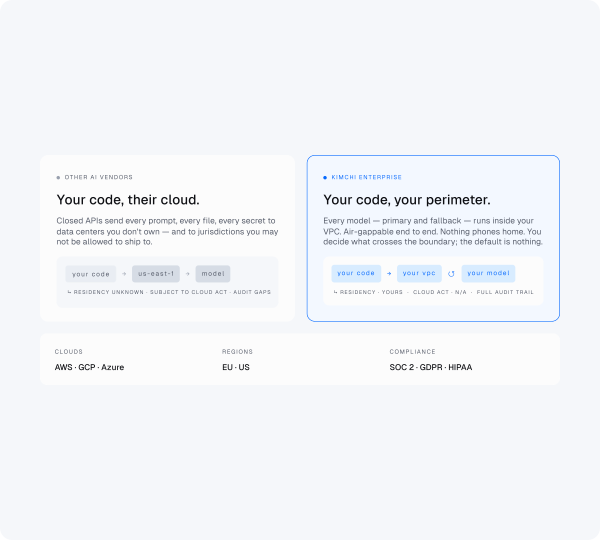
Open-source models run inside the customer's own AWS, GCP, or Azure cloud account, and prompts, completions, and code are never transmitted externally. This structure can be used to meet data sovereignty requirements in regulated environments where data must not leave the organization's boundary.
Governance & Guardrails
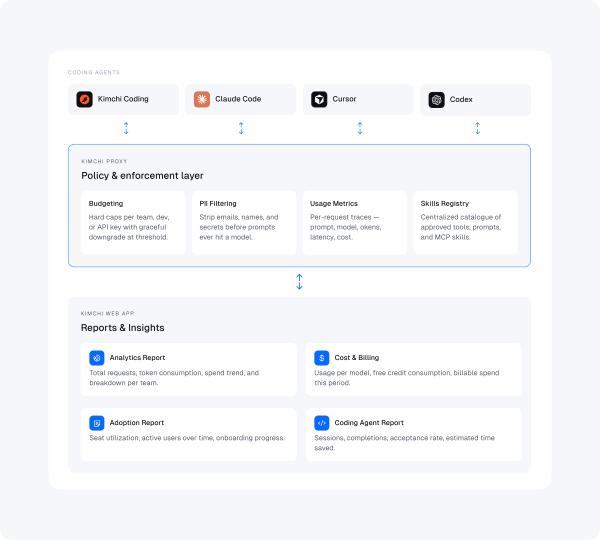
Every coding agent request within the organization passes through the Kimchi Proxy, where budget limits, PII filtering, usage monitoring, and an approved skill registry are applied before the model is ever called. It's designed to help prevent unapproved code merges, secret leaks, and uncontrolled spending.
Cost Visibility
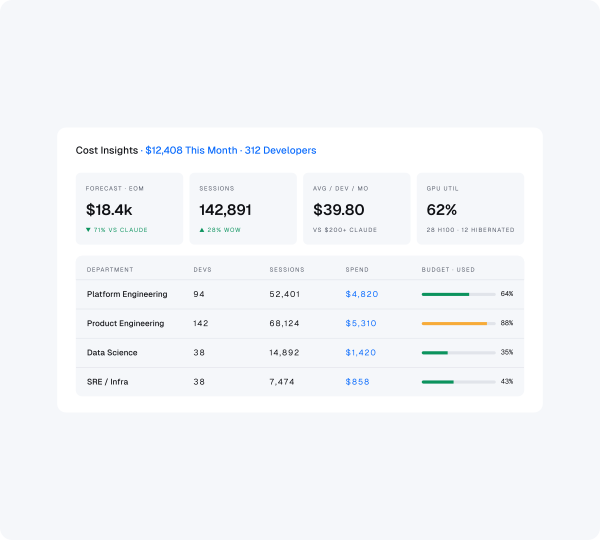
AI usage costs can be tracked in real time by developer, team, model, and tag. Spending can be forecast before it scales, reducing the operational risk of only discovering costs when the monthly bill arrives. Spending limits can be set anywhere from the individual API key level up to the organization-wide level, and there's also a feature to automatically terminate runaway agent loops that fall outside expected bounds.
Hybrid Model Routing
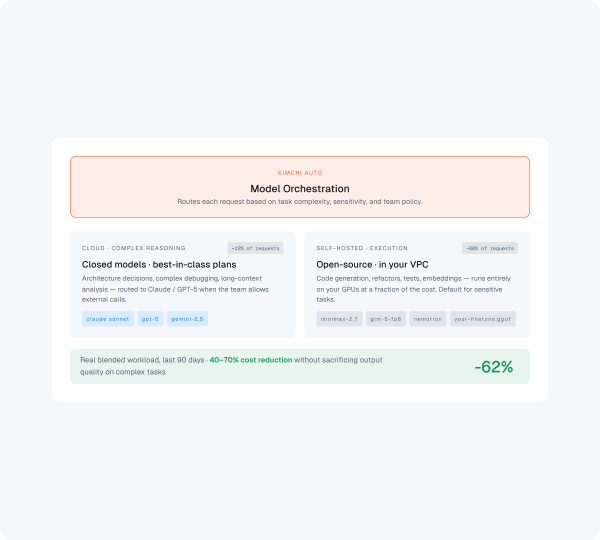
Tasks requiring reasoning are automatically routed to high-performance models, while code generation and execution-focused tasks go to relatively lower-cost, self-hosted open-source models. Kimchi's orchestration layer classifies each task and assigns it to the most suitable model, managing cost by reserving high-performance models only for the most demanding tasks.
Easy Migration
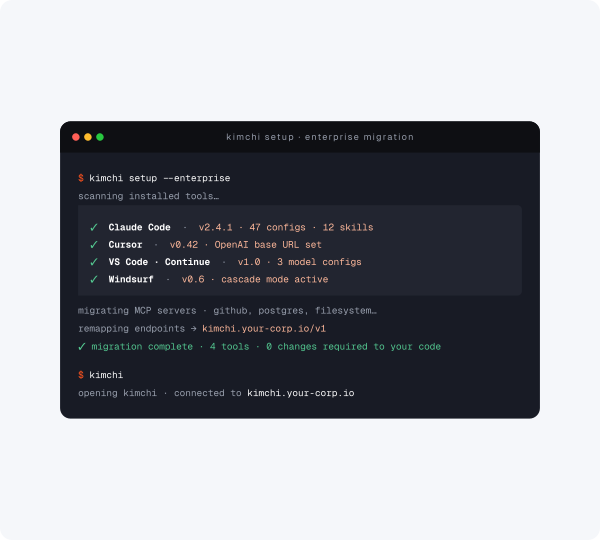
Kimchi automatically detects existing installed AI coding tools—Claude Code, Cursor, Continue, VS Code, Windsurf, and others—and migrates their endpoints. It provides an OpenAI-compatible API, allowing a switch with no code changes, and supports starting out serverless before moving to self-hosting later based on compliance or cost requirements.
Kimchi also supports integration with GitHub, GitLab, Jira, Confluence, Slack, Linear, PostgreSQL/MySQL, S3/GCS/Azure, Okta, Vault, and Datadog/Splunk, among others, allowing development teams to run AI coding workflows within the tool environment they already use.
☑️ Deployment and compliance
Kimchi runs as an operator inside the customer's own Kubernetes cluster, with autoscaling, hibernation, and monitoring managed automatically. Identity, networking, and underlying node management remain the customer's responsibility.
Compliance details vary slightly depending on the official source. Kimchi's enterprise page lists SOC 2 Type II certification, GDPR and DORA requirements built into the design, a HIPAA-ready architecture (BAA available on request), and FedRAMP Moderate in progress. The MiniMax M3 press release lists SOC 2, GDPR, ISO 27001, and PCI-DSS support. Since these two sources list different items, it's necessary to confirm the latest official materials when evaluating adoption.
Cast AI also announced that Kimchi Coding, Kimchi's coding agent product, became the first autonomous coding agent to offer access to MiniMax M3. M3 is applied as the default builder model in the Kimchi orchestration layer, and according to Cast AI's announcement, it scored 59% on SWE-bench Pro, a benchmark based on real GitHub issues. This feature is being rolled out in stages through an early access program. Cast AI stated that in its own shadow-mode evaluation compared against a commercial-model-only baseline, Kimchi cut costs by 2.5x while matching or exceeding spec-adherence and test-pass rates.
☑️ Frequently Asked Questions
Is self-hosting really cheaper at scale?
Self-hosting becomes cost-effective once monthly AI inference spend reaches roughly $3,000–$5,000. Most companies with 50+ developers fall into this range; below that, serverless is generally more advantageous.
How does open-source model quality compare to commercial models?
For execution-focused tasks like code generation, refactoring, test writing, and embeddings, open-source models perform on par with or better than commercial models in real-world use. For tasks requiring planning or complex reasoning, hybrid routing allows commercial models to be used alongside them.
Which compliance frameworks does it support?
It holds SOC 2 Type II certification, with GDPR and DORA requirements built into the design. A HIPAA-ready architecture is supported via BAA on request, and FedRAMP Moderate certification is in progress. Individual customer audits are also supported.
How much operational burden is involved?
Kimchi runs as an operator inside the customer's own Kubernetes cluster, with autoscaling, hibernation, and monitoring managed automatically. Identity, networking, and underlying node management remain the customer's responsibility, and most customers spend under one SRE-day per month on operations.
Does it support air-gapped environments?
Yes, it supports full air-gapped environments where all models, including fallback models, run entirely inside the customer's own infrastructure. There are no external calls, no telemetry, and no model updates without customer approval, and it can be deployed as a single signed bundle.
How do you move from serverless to self-hosted?
You only need to change the base URL setting to point to your own domain—the API, SDK, and code all stay the same.
☑️ Closing
Kimchi is Cast AI's coding agent that runs AI coding and inference inside the customer's own cloud account while providing model routing, governance, and cost management together. For organizations that need data sovereignty, cost control, and compliance support all at once, it's a structure worth considering when evaluating adoption.
Cloud Networks, as Cast AI's official partner in Korea, supports adoption reviews tailored to customer environments, and can help evaluate the right deployment approach between serverless and self-hosted, data sovereignty requirements, cost structure, and integration direction with existing AI coding tools. If you'd like to discuss your adoption direction, please contact Cloud Networks.
▶ Cast AI Learn More
[Sources: Cast AI, "Kimchi.dev - Enterprise AI coding and inference"; Cast AI, "Cast AI's Kimchi Coding Becomes the First Autonomous Coding Agent to Offer MiniMax M3, Delivering Frontier Open-Weight Performance at a Fraction of the Cost"]